Do the best you can
Six words that sound like encouragement, humility, and uncertainty, often all at once.
Editor in Chief
Executive Abstract
"Do the best you can." Six words that arrive on a dental Rx as a mix of encouragement and uncertainty. This editorial explores the technical and social implications of the incomplete record in crown and bridge fabrication. When margins are not continuous and scans are uncertain, precision alone cannot manufacture certainty. We examine why "fits the model but not the mouth" remains one of the most consequential phrases in lab policy.
Key Findings
- Precision is not the same as certainty; digital workflows can preserve and even accelerate uncertainty if not properly checked.
- "Fits the model but not the mouth" describes a data problem where the record fails to capture the full clinical truth.
- The "Do the best you can" instruction is often a social efficiency masking a technical imprecision.
- Classifying uncertainty (Margin, Bite, Scan, etc.) is the first step toward building a disciplined quality control protocol.
In a dental laboratory, the phrase is familiar enough to be funny and serious enough to show up in remake and warranty conversations. It usually arrives on an Rx, the dentist’s laboratory prescription, the instruction sheet and clinical record package from which a crown, denture, implant restoration, or other appliance is made.
Sometimes the phrase means, “Use your judgment.” Sometimes it means something more specific: the clinical conditions were imperfect, the margin was difficult to capture, the patient moved, the tissue bled, or the bite was hard to verify.
And the case still needs to move. That is not necessarily negligence. Often, it is dentistry.
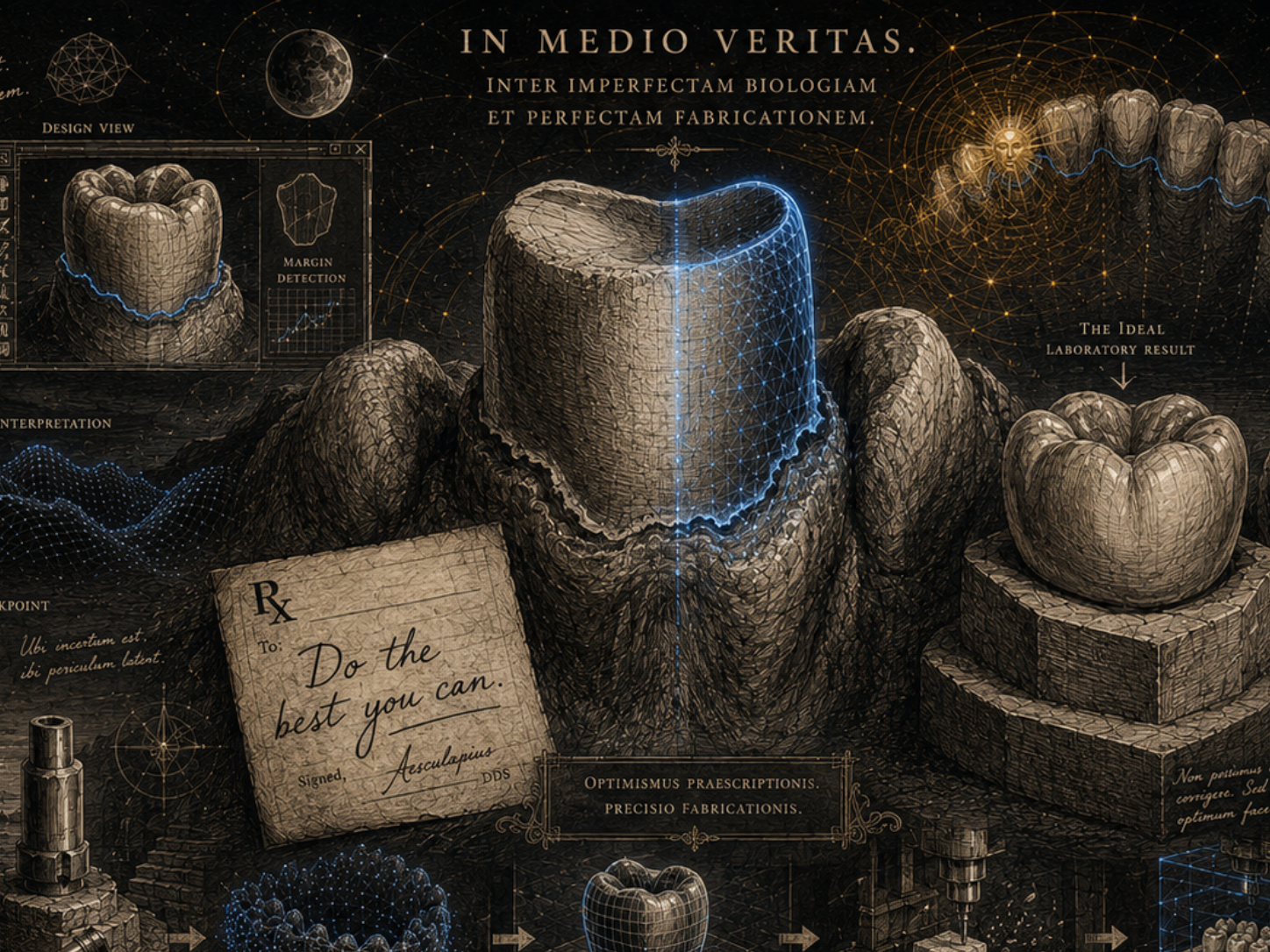
A dental lab does not fabricate from optimism. It fabricates from records. When those records are complete, “best” is a useful word. When the records are incomplete, “best” becomes a more complicated word. It may mean: proceed carefully inside imperfect reality.
The tooth with an incomplete margin
The most useful strange phrase in this story is not “Do the best you can.” It is: “The margin is not continuous.”
In crown fabrication, the margin is the boundary where the crown should end. If an impression or scan does not capture that boundary clearly all the way around, the lab does not have a complete instruction. It has a partial record of a clinical fact.
A crown has to end somewhere. The mouth is specific about the address. A skilled technician can refine contour and design contacts, but an uncaptured margin remains uncaptured. This is not a moral failure; it is a data problem occurring in a biological environment that does not always cooperate with data collection.
The crown that passed the wrong test
This leads to another useful phrase from lab policy: “Fits the model but not the mouth.”
The lab may have made the restoration accurately to the record, but the record itself was unable to capture the full clinical truth. The object passed the test it was given, but the mouth had a different exam prepared.
That distinction matters more as dentistry becomes more digital. A scanner can make uncertainty look cleaner. A CAD file can preserve uncertainty precisely. A mill or printer can manufacture uncertainty efficiently. AI may help identify uncertainty earlier, but it should not be asked to make uncertainty true.
Precision is not the same as certainty. A digital workflow can be fast and beautifully organized, yet still be limited by the clinical reality that produced the record.
The official-looking uncertainty
The implant scan body is the modern version of the same problem. It looks digital. It looks official. But if the connection or seating is uncertain, that uncertainty enters the design. The lab may then fabricate an implant restoration that is precise to the file and wrong for the patient.
The next generation of dental technology should not merely help teams move faster. It should help them recognize when speed is about to manufacture uncertainty.
Why everyone keeps saying it
There are humane reasons people say “Do the best you can.” Patients move, bleed, gag, and fatigue. Retakes cost chair time and goodwill. Dentists work in mouths, not diagrams. Everyone is trying to help, and everyone is also trying not to stop.
That is why the phrase survives. It is socially efficient but technically imprecise. When it is not handled carefully, it can create a quiet fiction: everyone behaves as though uncertainty has been communicated, while no one has decided what the uncertainty means.
Name the uncertainty
The better response is not blame; it is classification. Once the uncertainty has a name—a margin problem, a bite problem, a scan problem—it can have a protocol.
- Green: Proceed. The records are usable.
- Yellow: Clarify first. The case may proceed after clinical signoff or specific clarification.
- Red: Pause or retake. The missing information is essential.
This is where ambiguity stops being friendly. It becomes a decision.
Do not invent biology
The rule is simple: Do not invent biology. Do not invent margins. Do not invent occlusion.
A lab can fabricate only to the data it has. If the model does not fully represent the mouth, the achievement has a ceiling. This is not an argument for perfectionism—compromises are sometimes humane—but a compromise should be named.
The next level of “best”
The dental revolution will not be measured only by speed. It will also be measured by how well the system recognizes uncertainty and communicates it clearly.
The next level of “Do the best you can” is not heroic improvisation. It is evidence-aware dentistry: capture better, flag sooner, communicate clearer, and recognize when imperfection is the condition under which clinical judgment begins.
Sometimes the best work begins by knowing how much certainty the case actually contains.
Clinical and Industry Implications
For Dentists
Recognize that "Do the best you can" is a question, not an instruction. Clarify which compromises are acceptable and which require a retake.
For Laboratories
Classify uncertainty early. Move from poetic notes to structured quality checkpoints (Green/Yellow/Red) to protect clinical outcomes.
For Manufacturers
Design software and hardware that doesn't just "fill in the gaps" but flags ambiguous data for human review.
What Remains Uncertain
The boundary between acceptable compromise and clinical failure remains subjective and case-specific. While digital tools can flag uncertainty, the final decision on "good enough" remains a human judgment call between the dentist and the technician.
Definitions
Frequently Asked Questions
Why can't the lab just "fix" a bad margin?
A lab can infer a plausible margin based on morphology, but it cannot know the actual clinical boundary if it wasn't captured. "Fixing" it means guessing, which risks poor fit or tissue irritation.
Does digital scanning eliminate margin uncertainty?
No. While digital tools provide clearer visualization, they can still be limited by moisture, blood, or tissue retraction issues just like analog impressions.