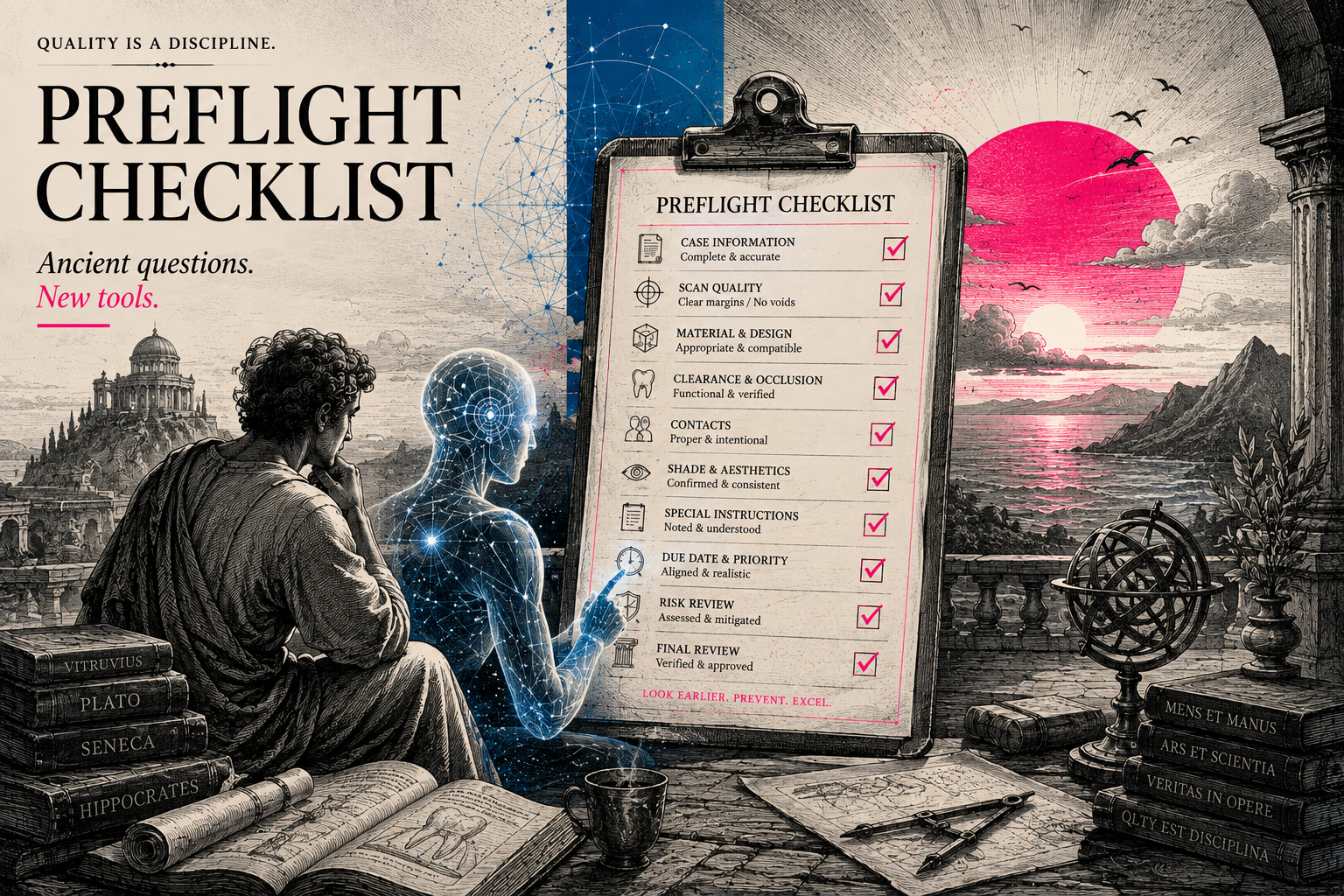
Preflight Checklist:
Good Enough Was a Budget
AI won't make your laboratory perfect. It may make exceptional diligence practical for ordinary work.

Norbert Ulmer
Editor in Chief
Executive Abstract
The modern dental laboratory faces a fundamental tension between the economic pressure of "good enough" production and the hidden costs of inadequate preflight review. This article examines how structured quality checkpoints—case information validation, scan quality assessment, material verification, clearance confirmation, and risk review—transform laboratory economics by preventing errors before they propagate into remakes, adjustments, and relationship damage. The argument is not that every case deserves equal scrutiny; it is that the decision to skip scrutiny should be intentional, documented, and economically informed rather than an accidental consequence of workflow compression.
Quick Answer
A preflight checklist is not bureaucracy. It is budget reallocation: moving time and attention from fixing problems that already exist toward preventing problems that would otherwise occur.
Key Findings
Routine cases processed with lighter oversight carry measurable hidden costs in remakes and adjustments
The arithmetic of looking earlier shows that pre-production review prevents cascading failures
Structured checklists convert tacit technician knowledge into explicit, trainable protocols
AI-assisted preflight tools are emerging but do not replace human judgment at key decision points
'Good enough' was never a philosophy—it was a budget constraint that laboratories could no longer afford
The most valuable quality investment is often the one that prevents the first error, not the one that catches the last
Quality Is a Discipline
The preflight checklist transforms laboratory economics through intentional prevention
The Arithmetic of Looking Earlier
Consider a routine case, the kind your laboratory processes a hundred times a month. A zirconia crown, lower left first molar. The scan is there. The shade is attached. The due date looks manageable.
But the prescribed material, the available clearance, and the design instruction do not quite agree. One margin is difficult to read. A note from an earlier case records that this dentist prefers heavy contacts, and nobody knows whether that preference applies here.
Now follow the case forward. An experienced technician catches the conflict at intake and resolves it in four minutes. Or the conflict survives intake, and CAD begins. Or it survives milling, and the restoration is finished, glazed, boxed, and shipped. Or it reaches the chair, where the dentist discovers that the case needs another conversation, another adjustment, perhaps another appointment.
Same case. Four endings. What changes is not the commitment or skill of the people involved. It is the point at which enough attention reaches the case.
For years, giving every routine case the depth of review an experienced technician might provide was economically unrealistic. Laboratories built sensible workflows around that fact: scarce expertise went toward the cases most likely to need it, while routine work moved with lighter oversight. The people who designed those workflows were not careless. They were doing arithmetic.
Good enough was not a philosophy. It was a budget.
Every Laboratory Has One
It can invest in preventing problems, inspecting work, correcting issues before delivery, or addressing them after they reach the dentist or patient. Quality-management literature calls these prevention, appraisal, internal-failure, and external-failure costs. The terminology matters less than what every laboratory owner already knows: quality is paid for somewhere, whether through careful intake, technician time, remilling, rescheduling, shipping, phone calls, or the effort required to preserve a customer relationship. (1)
For most of the history of the modern dental laboratory, some forms of diligence were simply too expensive to apply to every case. What is beginning to change is the cost of looking earlier. Structured software, automation, retrieval systems, computer vision, and increasingly AI can make it possible to compare more information across more cases before expensive work begins.
This is not a distant prospect. In a mid-2026 survey from the American Dental Association's Health Policy Institute, 43.3 percent of responding dentists reported using AI for at least one task and another 26.4 percent planned to, concentrated in imaging, administration, and front-desk work rather than treatment decisions — though the panel was self-selected and likely skews more digital than the profession as a whole. (2) Standards are arriving alongside adoption. ANSI/ADA Standard No. 1110-1:2025 now addresses validation datasets and image annotation for radiographic AI, and an April 2026 IADR and AADOCR ethics statement called for rigorous validation, continuous monitoring, accountability, and meaningful human review. (3) (4)
That may turn out to be one of AI's most consequential effects on dental laboratories. Not raising the ceiling of what the very best technician can do.
Raising the floor of what every routine case can receive.
The Expertise We Want to Extend
Dental laboratories have always depended on people who notice things. The technician who sees that the preparation and requested material are a poor match. The person who remembers that a particular account prefers a certain contact. The production manager who senses that one combination of case design and due date deserves attention now rather than tomorrow. The senior ceramist who looks at something everyone else considers acceptable and knows it can still be better.
In many independent laboratories, institutional knowledge does not primarily live in manuals or databases.
It lives inside experienced people.
That is part of what makes a good laboratory good. It is also difficult to scale. The U.S. Bureau of Labor Statistics counted roughly 35,200 dental laboratory technicians in 2024 and projects employment in the occupation to decline about 5 percent by 2034, while annual openings continue largely because people retire or move into other work. BLS expects digital manufacturing and other labor-saving technologies to absorb part of the changing workload. (5)
This makes the transfer of expertise more valuable, not less. The interesting question is not how to replace an experienced technician with software. It is how much of what experienced technicians routinely notice can become part of the laboratory's operating system.
If a senior technician has learned to check the same ten conditions every time a case arrives, perhaps eight of them can be surfaced automatically. If a production manager repeatedly assembles the same information before deciding whether a case needs attention, perhaps that information can arrive already organized. If the same technician corrects the same design issue every week, perhaps part of that correction can become organizational knowledge rather than remaining personal knowledge.
That changes the role of expertise. The expert spends less attention searching for routine exceptions and more attention interpreting the difficult ones — which means AI does not have to make expertise less important.
It can make expertise more available.
The Inheritance Gap
Technology changes what is possible faster than organizations change what is normal. That creates what we might call the inheritance gap:
The distance between the quality an organization could now sustain and the lower standard it continues to reproduce because its routines were built under earlier constraints.
Organizational research has long shown how routines become self-reinforcing. Path dependence, established competencies, prior investments, and the difficulty of unlearning can keep a process in place after the circumstances that created it have begun to change. (6)
You can see this in almost any laboratory. A team becomes very good at chasing missing information. Someone becomes the expert at rescuing rush cases. A production manager develops an informal system for remembering where work tends to stall. A senior technician knows exactly which questions to ask when something does not feel right.
These are valuable capabilities. But they can also make an underlying opportunity less visible. When an organization becomes excellent at recovering from a recurring problem, it may stop asking whether the problem itself could now be prevented earlier. Healthcare research on the normalization of deviance describes a related pattern: when deviations become familiar and do not consistently produce immediate harm, they can gradually come to feel normal. (7)
The interesting question, then, is not merely whether technology can detect something. It is whether the organization is prepared to act on what it finds. A system can identify missing information, but someone still needs the authority to clarify it. It can surface a material conflict, but someone still has to weigh the tradeoff. It can reveal a recurring remake pattern, but someone still has to decide whether the workflow should change.
Technology can reduce the cost of noticing.
The organization still has to decide what deserves to become a new standard.
The Customer Is Part of the Quality System
Dental laboratories have another constraint that purely technical discussions often miss. The laboratory does not operate alone. It operates in a relationship with the dentist.
Imagine that a better preflight process identifies limited clearance, an incomplete scan, a material conflict, or an ambiguous prescription. That information is valuable. But the laboratory still has to decide what to do with it and how to communicate it.
Some dentists will welcome an early clarification. Others value a laboratory precisely because it can interpret ambiguity without repeatedly interrupting them. Some situations justify pausing a case. Others may justify proceeding with a conscious compromise, because another appointment for the patient would create a greater burden than the technical limitation itself.
So the higher standard cannot simply be find more problems and stop more cases. A better standard is:
Make consequential exceptions visible early enough that the laboratory and dentist can choose deliberately rather than discover them accidentally later.
That is a more useful definition of quality, because it aligns diligence with service rather than setting the two against each other. A thoughtful preflight process should help the laboratory distinguish among a genuine hard stop, a useful clarification, an issue it can reasonably resolve internally, and a conscious, professionally defensible exception.
The goal is not fewer compromises.
It is better-informed compromises.
Raising the Floor Through Coverage
Most conversations about dental AI begin with performance. Can it read a margin? Can it detect caries? Can it design a crown? Those questions matter, but for a laboratory owner another question may matter just as much:
How much of the work can receive a consistent first look?
A first completeness check on every case. A first comparison between the prescription and material requirements. A first review of whether required files are present. A first classification of every remake. A first prompt when a case stops moving. A first retrieval of customer-specific information that may matter.
The word first is important.
The objective is not to turn the first pass into the final answer. It is to make a basic layer of diligence available across more of the laboratory.
A 2011 audit of 150 dental laboratory prescriptions found roughly two-thirds did not comply with the relevant prescription requirements. It was a small, single-setting study, but the underlying challenge remains familiar: important information can be incomplete even when clinicians and technicians are working toward the same outcome. (8)
Rework creates a similar opportunity for better visibility. A U.S. practice-based study of 3,750 single-unit crowns reported an overall remake rate of 3.8 percent, with substantial variation among practitioners. (9) Not every remake is preventable. Biology, clinical changes, patient preferences, esthetic decisions, and reasonable professional compromises all matter.
The opportunity is not zero remakes. It is knowing more clearly which remakes contain preventable organizational learning. And that begins with defining what the laboratory wants to count. A useful internal definition might be:
A case represents preventable rework when work had to stop, be redone, or be remade because of information that was present or reasonably obtainable earlier, and a proportionate earlier review could reasonably have changed the outcome.
Track separately the things that belong somewhere else: doctor-requested changes after an acceptable delivery, biological changes, esthetic reselection, and conscious, documented compromises that behaved as expected.
A laboratory that can distinguish those categories already understands its quality more deeply than one that reports only a single remake percentage.
Better Visibility Requires Better Judgment
The fact that technology can find more does not mean every finding should change the work. This is one of the most useful lessons from clinical AI research.
A 2026 systematic review and meta-analysis of AI-supported dental diagnosis and treatment planning pooled 27 studies and more than 60,000 radiographic images, reporting encouraging sensitivity and specificity. But the research was heterogeneous, much of it retrospective, and evidence about downstream clinical decisions remained less developed than evidence about image-level detection. (10) Controlled studies show why that distinction matters. In one randomized trial, AI improved dentists' diagnostic performance while also increasing both noninvasive and invasive treatment decisions. (11)
The ADEPT study makes it concrete. Twenty-three dentists read bitewings with and without AI assistance. Detection of enamel-only proximal caries rose from 44.3 percent to 75.8 percent — and incorrect identification of healthy surfaces rose from 3.7 percent to 14.6 percent. (12)
Detection improved substantially. So did the rate of flagging something that did not need attention.
The lesson translates easily to laboratory preflight: a system that surfaces more possible concerns may also create more reviews that turn out not to require action. So the objective is not maximum detection. It is useful discrimination.
Universal appraisal must not become universal intervention.
Another study makes the same point from a different angle. A commercial AI system evaluating panoramic radiographs achieved very high tooth-level accuracy across the treatment features studied, yet only 56.5 percent of complete patient reports were entirely free of discrepancies. (13) Small local error rates compound across a full case — and a laboratory does not deliver an isolated measurement.
It delivers a case.
That is why the performance question should always move from did the tool identify this feature correctly? to did the complete process produce a better outcome?
The same principle applies to AI-assisted crown design. A 2026 systematic review found generally acceptable morphology, fit, and occlusal outcomes in available studies, with reductions in initial design time in some settings. But much of the research remained in vitro or computational, and experienced refinement continued to matter in complex and esthetically demanding cases. (14) That suggests a promising division of labor: an automated baseline can raise the floor, and craftsmanship determines how far above it the case should go.
Start With the Simplest Tool That Works
One of the most useful findings in the research is that raising the floor does not always require sophisticated AI.
A 2024 study comparing conventional laboratory communication with an integrated information system across 600 prescriptions found more complete information, less repeated communication, faster completion and delivery, and fewer modifications or redos in the digital workflow. The study was nonrandomized and context-specific, but the mechanism was straightforward: better structure improved information flow. (15) A 2026 prospective study of prosthodontic clinic-laboratory transfers found fewer delays and fewer delayed days when cases moved through a digitally tracked workflow using checkpoints and overdue alerts. (16)
Required fields. Timestamps. Alerts. Owners.
The practical principle is simple:
Start with the simplest tool that reliably removes the constraint.
A mandatory field may be enough. A checklist may be enough. A deterministic material rule may be enough. A clearly assigned owner may be enough.
AI becomes especially useful where structure alone stops working — and dental laboratory intake is full of exactly those situations. Cases arrive through scanner portals, laboratory-management systems, emails, free-text notes, phone conversations, photographs, PDFs, paper prescriptions, and the accumulated history of prior cases. No single intake form captures all of it.
That is where AI becomes especially interesting. Rules handle information that is explicit and structured; AI can help organize what is scattered, unstructured, contextual, or difficult to compare manually. A free-text instruction can be compared with the selected material. A current case can be connected with a relevant preference from prior work. Several messages can be distilled into one coherent record before CAD begins.
The opportunity is not AI instead of structure.
It is structure first, AI where structure runs out.
What Preflight Is Worth
Before investing in a more sophisticated preflight process, measure the problem. Many laboratories know their remake rate reasonably well. Fewer know how often technicians pause to clarify something, how often CAD begins before an issue is discovered, how much time experienced technicians spend quietly resolving routine exceptions, how frequently late clarification changes a due date, or how often the same type of problem repeats.
Those quiet catches matter. They represent organizational diligence already being performed, just informally. So the first investment may not be software.
It may be thirty days of better counting.
Suppose a laboratory processes 1,000 crown cases per month. If a preflight process flags 12 percent of cases and each flagged case requires five minutes of review by someone costing $35 per hour fully loaded, the human review burden is about ten hours per month, or roughly $350. If the process flags 25 percent and each review takes eight minutes, the burden rises to roughly 33 hours, or a little more than $1,100. Those are illustrative numbers, not benchmarks — but the insight holds: the value of the system depends less on how many things it can flag than on how well it distinguishes useful exceptions from ordinary variation.
Then count the value created upstream. A question answered before design may save only a few minutes. An issue discovered after milling may consume material and production capacity. An issue discovered after delivery can involve the dentist, patient, chair schedule, shipping, and customer relationship. The farther downstream the problem travels, the more people and resources tend to become involved.
That is the economic case for looking earlier. Not that every problem disappears — that fewer small uncertainties get the opportunity to become expensive ones.
The actual technology cost should be measured just as carefully. Sometimes preflight can be added to systems a laboratory already uses. Sometimes improving the workflow requires integration, configuration, data cleanup, staff training, or a broader platform decision. Those costs belong in the calculation too. The laboratory should evaluate the complete process, not simply the software subscription.
Making Preflight Feel Like Better Service
A better quality process should make the laboratory easier to work with, not harder. That means the customer conversation matters as much as the detection system.
One way to set expectations with an account might be:
"We've moved more of our case review to the beginning of the process. The goal is to resolve the things that matter before design rather than later, so when we do need to reach out, we can give you a clear reason and a clear option."
A clarification can follow the same principle:
"Dr. Chen, we caught something before we started design. The prescription calls for full-contour zirconia, and the available occlusal clearance is limited in one area. We can proceed with a different material option, or you can revise the preparation. Let me walk you through the tradeoff."
The goal is not to prove the laboratory right. It is to make the decision easier for the dentist. And sometimes the appropriate outcome will still be to proceed — which can be perfectly reasonable when the limitation is understood and the tradeoff is deliberate.
Different accounts may also prefer different levels of involvement. Some dentists value proactive consultation on technical questions; others intentionally rely on the laboratory to resolve routine ambiguity within agreed boundaries. A mature preflight process can accommodate both. It does not need to treat every account, case, or exception identically, and that flexibility is one of the advantages of becoming more deliberate about the process in the first place.
A mature quality system does not eliminate exceptions. It makes them visible, explainable, and intentional.
The 30-Day Imperfection Audit
The best place to start is not with a list of AI tools. Start with your laboratory. Get a few experienced people together and ask:
What are the five recurring problems here that everyone is tired of seeing?
List them before discussing technology. Perhaps they are incomplete prescriptions, scan issues discovered during CAD, repeated contact adjustments, shade remakes, customer preferences that only one person remembers, rush cases that repeatedly surprise production, the same bottleneck appearing every week, or the same design correction being made again and again.
These recurring irritations are not merely annoyances. They are information about the organization.
Take them one at a time. First, determine what kind of imperfection you are looking at.
- Inherent uncertainty and justified variation include biology, esthetics, patient preference, and reasonable professional disagreement. These require judgment rather than elimination.
- Inherited compromise includes recurring problems that were once reasonable because prevention, review, information retrieval, or coordination cost too much.
- Technology-created imperfection includes excessive alerts, unnecessary holds, hidden correction time, overconfidence, homogenized output, or new dependencies created by the solution itself.
Then ask six questions:
- What recurring shortfall have we normalized?
- What originally made it reasonable?
- Has that constraint materially changed?
- Could a simpler intervention solve it?
- What new burden, customer friction, or loss of judgment might the higher standard create?
- What evidence would justify making the higher standard part of ordinary work?
The conclusion does not have to be "automate it." Sometimes the old compromise really has become unnecessary. Sometimes the right answer is a small pilot. Sometimes the economics still do not work. And sometimes what initially looks like an imperfection is actually useful flexibility or justified professional discretion.
The goal is not zero exceptions.
It is exceptions made on purpose.
Then run the smallest useful experiment. Pick one of the five recurring problems. Measure its frequency and full cost for 30 days. Only then ask whether a cheaper form of diligence, AI or otherwise, can prevent enough of it to justify changing the normal process.
Problem first. Economics second. Technology third.
When the Standard Begins to Move
Commercial availability is not the same as evidence. Technical feasibility is not the same as economic feasibility. And a capability becoming affordable does not automatically make it a professional obligation.
One laboratory may improve case intake with AI-assisted preflight. Another may reach the same standard through better forms, clearer rules, stronger training, and disciplined human review. What matters is the outcome, not the novelty of the tool.
Dentistry is also still developing the measurement infrastructure required to evaluate many of these changes. A systematic review identified more than 200 dental quality measures while finding limited formal validity or reliability evidence for many. (17) The ADA's Dental Quality Alliance is continuing to develop electronic dental-record measures for internal quality improvement and technical evaluation. (18)
That is another reason to start locally and concretely. Do not begin by asking whether your laboratory is using enough AI. Ask whether the same recurring problems continue to consume attention, material, goodwill, and expertise — then ask whether the economics of preventing them have changed.
Return to the crown. The material and clearance still do not quite agree. The margin is still difficult to read. The historical preference may or may not apply. A better process surfaces those questions before CAD begins, and an experienced technician reviews the ones that matter. Perhaps the dentist changes the material. Perhaps another scan is useful. Perhaps everyone understands the limitation and consciously chooses to proceed.
Nothing about the case becomes perfect. Biology remains uncertain. Esthetics remain interpretive. Craftsmanship still matters. The dentist and technician still have judgment to exercise. What changed is simply the ability to bring more diligence to the case while there is still time to use it well.
That may be the more interesting promise of AI for dental laboratories. Not replacing expertise.
Extending its reach.
And if a higher standard of everyday diligence becomes practical, the most useful question may be:
Which compromises would we still choose if we were designing the laboratory today?
Core Thesis
Quality is a discipline. The preflight checklist is not about perfection. It is about intentionality—deciding, case by case, how much attention each case deserves, applying that attention at the point where it creates the most value, and building a culture where looking earlier is normal rather than exceptional.
Source Notes & References
- 1.
American Society for Quality. “Cost of Quality.” Definitions of prevention, appraisal, internal-failure, and external-failure costs. [Link]
- 2.
American Dental Association Health Policy Institute. “Dentists AI Usage and Attitudes.” July 2026. [Link]
- 3.
American Dental Association. “Artificial Intelligence in Dentistry.” Includes ANSI/ADA Standard No. 1110-1:2025 and ADA Technical Report No. 1109:2025. [Link]
- 4.
International Association for Dental, Oral, and Craniofacial Research and American Association for Dental, Oral, and Craniofacial Research. “Policy Statement on Ethics in Artificial Intelligence in Dental, Oral, and Craniofacial Research.” April 2026. [Link]
- 5.
U.S. Bureau of Labor Statistics. “Dental and Ophthalmic Laboratory Technicians and Medical Appliance Technicians,” Occupational Outlook Handbook. 2024 employment and 2024–2034 projections. [Link]
- 6.
Sydow, J., Schreyögg, G., and Koch, J. “Organizational Path Dependence: Opening the Black Box.” Academy of Management Review 34, no. 4 (2009): 689–709. [Link]
- 7.
Banja, J. “The Normalization of Deviance in Healthcare Delivery.” Business Horizons 53, no. 2 (2010): 139–148. [Link]
- 8.
Stewart, C. A. “An Audit of Dental Prescriptions Between Clinics and Dental Laboratories.” British Dental Journal 211 (2011). [Link]
- 9.
McCracken, M. S., et al. “Remake Rates for Single-Unit Crowns in Clinical Practice: Findings From the National Dental Practice-Based Research Network.” Journal of Prosthodontics 28 (2019). [Link]
- 10.
Alabdulkareem, M., et al. “Artificial Intelligence in Dental Treatment Planning and Diagnostic Decision-Making: A Systematic Review and Meta-Analysis.” Clinical and Experimental Dental Research (2026). [Link]
- 11.
Mertens, S., Krois, J., Cantu, A. G., Arsiwala, L. T., and Schwendicke, F. “Artificial Intelligence for Caries Detection: Randomized Trial.” Journal of Dentistry 115 (2021): 103849. [Link]
- 12.
Devlin, H., Williams, T., Graham, J., and Ashley, M. “The ADEPT Study: A Comparative Study of Dentists’ Ability to Detect Enamel-Only Proximal Caries in Bitewing Radiographs With and Without AssistDent Artificial Intelligence Software.” British Dental Journal 231 (2021): 481–485. [Link]
- 13.
Kazimierczak, N., Sultani, N., Chwarścianek, N., et al. “Detection Accuracy of an AI Platform for Dental Treatment Features on Panoramic Radiographs: Tooth- and Patient-Level Analyses.” Scientific Reports 16, 2436 (2026). [Link]
- 14.
Holiel, A. A., Al Nakouzi, M. M., Cuevas-Suárez, C. E., et al. “Accuracy and Functional Performance of Artificial Intelligence-Based Automated Crown Design Systems: A Systematic Review and Meta-Analysis.” 2026. [Link]
- 15.
Nusairat, F. T., et al. “Enhancing Communication Between Dental Laboratories and Clinics: The Role of Information Technology Systems in a Developing Country.” Clinical, Cosmetic and Investigational Dentistry (2024). [Link]
- 16.
Tsai, Y.-H., Ye, S.-Y., Kuo, T.-C., et al. “Development of a Prosthodontic Workflow Tracking System to Improve Delivery Efficiency in Clinic-Laboratory Transfers.” Digital Health (2026). [Link]
- 17.
Righolt, A. J., Sidorenkov, G., Faggion, C. M., et al. “Quality Measures for Dental Care: A Systematic Review.” Community Dentistry and Oral Epidemiology 47, no. 1 (2019): 12–23. [Link]
- 18.
American Dental Association, Dental Quality Alliance. “Dental Quality Measures.” [Link]