The New Visual Decision Layer in Dentistry
How AI-assisted patient visualization is transforming case presentation from clinical explanation to emotional experience.

Norbert Ulmer
Editor in Chief
Executive Abstract
AI is moving into the space between clinical evidence and patient decision-making, changing case presentation from an explanation into an experience. This shift—from helping clinicians detect problems to helping patients emotionally evaluate solutions—creates a new "visual decision layer" in dentistry. While powerful for communication, AI-assisted patient visualization carries significant risks. When patients are shown highly realistic, AI-generated possible futures, they may mistake aspirational images for clinical promises. This article examines the distinction between evidence visualization and aspiration visualization, the changing role of dental laboratories as the "realism layer," and the compliance and trust challenges practices face. The future of dental case presentation will not be determined solely by image quality, but by whether patients can trust what those images mean.
Quick Answer
The "visual decision layer" refers to the growing use of AI-generated images, smile previews, and simulations to help patients emotionally evaluate dental treatment before understanding clinical requirements. While these tools improve communication, they require strict governance to ensure patients do not mistake aspirational simulations for guaranteed clinical outcomes.
Key Findings
- The Translation Gap: Dental AI is moving from diagnostic detection to patient-facing visualization, collapsing the time between consultation and perceived outcome.
- Two Types of Visualization: The market is splitting into "evidence visualization" (showing what is already in the clinical record) and "aspiration visualization" (showing a possible future).
- The Lab's New Role: As AI generates aspirational images instantly, dental laboratories become the "realism layer," translating synthetic previews into clinically feasible restorative designs.
- Automation Bias Risk: Highly realistic AI-generated smiles can anchor patient expectations, making it difficult to communicate subsequent clinical, biological, or financial limitations.
- Compliance is Product Quality: Patient-facing AI tools that process facial photos involve identifiable health information, requiring strict HIPAA compliance, Business Associate Agreements, and data governance.
A patient walks into a consultation already holding the future.
Not a treatment plan. Not a diagnosis. Not a wax-up. Not a doctor-approved design.
Just an image.
Maybe it came from a selfie-based smile preview. Maybe from an AI app. Maybe from a marketing funnel that promised a better smile in seconds. Maybe from a treatment coordinator who wanted to make the conversation easier. The image looks convincing. The patient has already studied it. They may have shown it to a spouse. They may have imagined themselves in it.
Then they say the sentence that will define the next era of dental case presentation:
"I want this."
That moment is where dentistry is heading.
For years, dental AI has been discussed mostly as a clinical technology: detection, diagnosis, segmentation, radiographic analysis, treatment planning, automation, and workflow support. But another category is rising just as quickly and may prove just as influential.
AI is moving into the space between clinical evidence and patient decision-making.
It is changing the case presentation from an explanation into an experience. It is helping patients see disease, understand options, imagine outcomes, and emotionally evaluate treatment before they fully understand what the treatment requires.
This is the rise of AI-assisted patient visualization and case presentation.
The category includes AI radiograph overlays, digital smile previews, scan-based orthodontic simulations, implant smile previews, restorative mock-ups, lab-linked smile design, AI-generated consultation narratives, and patient-facing education tools.
The core shift is simple:
Dental AI is moving from helping clinicians detect problems to helping patients understand and emotionally evaluate solutions.
That is why this category matters. It is not just software. It is becoming the new visual decision layer in dentistry.
What Is the Visual Decision Layer in Dental AI?
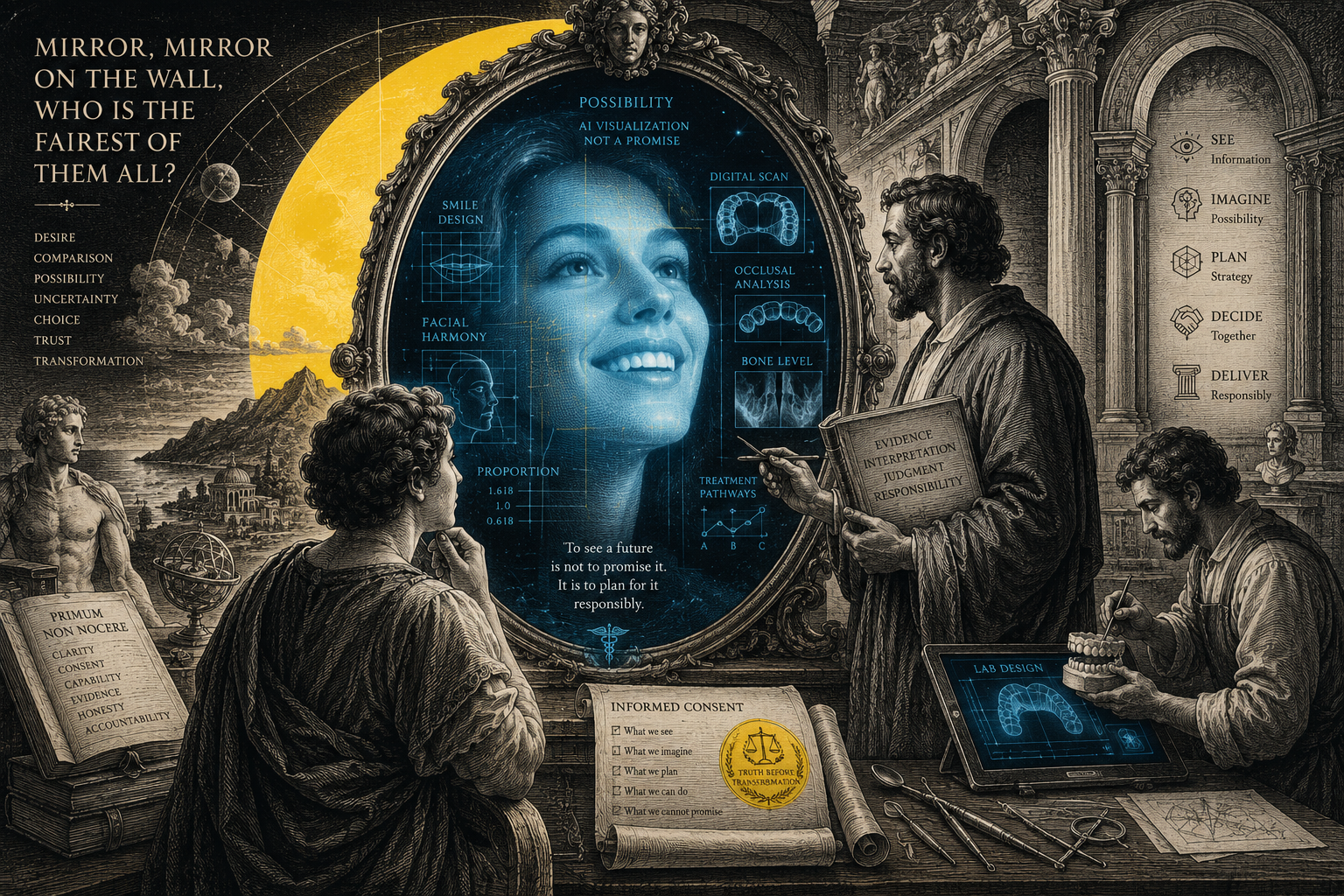
The visual decision layer is the new interface between clinical evidence, patient desire, treatment planning, and consent. It is where AI-generated images and simulations help translate what the dentist sees, what the patient wants, what the lab can build, and what the final treatment plan can responsibly promise.
That layer will be powerful.
It will also be risky.
Because when dentistry shows patients a possible future, the image can become more persuasive than the explanation.
The old case presentation asked patients to imagine.
The new one shows them a future.
Dentistry has always had a translation problem.
The dentist sees decay, bone loss, crowding, wear, inflammation, failing restorations, restorative space, occlusal risk, esthetic imbalance, and long-term consequences.
The patient often sees a bill, a fear, a vague discomfort, or a smile they have learned not to show.
Between those two realities sits the case presentation. For decades, that moment has depended on translation. The dentist explains. The patient tries to understand. Then the patient decides whether treatment feels necessary, desirable, affordable, and trustworthy.
Visual dentistry has always helped bridge that gap. Intraoral photos, radiographs, printed smile designs, diagnostic wax-ups, before-and-after cases, shade guides, physical models, and intraoral scanners all work because they turn invisible or technical dentistry into something patients can grasp.
AI does not invent that instinct. It accelerates it.
3Shape's TRIOS Smile Design is positioned around visualizing treatment outcomes on patient photos and designing desired results together, while TRIOS Treatment Simulator transforms scan data into simulated orthodontic outcomes for patient engagement and expectation-setting. [1][2]
Smilecloud describes a workflow that turns photos into facially aligned smile design, AI-assisted video simulation, and collaborative case planning. [3][4]
Align's Invisalign Smile Architect brings orthodontic and restorative visualization together through iTero scan-based case presentation. [5]
These examples are not the whole market. They are signals.
The dental consult is becoming visual-first. Once patients can see a possible future, the psychology of treatment acceptance changes.
A treatment plan is abstract. A picture is not.
A fee is abstract. A future face is not.
A clinical explanation asks the patient to believe. A realistic image invites the patient to feel.
That is the promise and the danger of this category.
Evidence vs. Aspiration: The Two Types of Dental AI Visualization
To understand AI-assisted visualization clearly, dental professionals need one distinction above all others.
There are two different kinds of AI visualization.
One shows what is already present.
The other shows what might be possible.
Both can be useful. But they are ethically different.
| Category | What it shows | Examples | Primary value | Primary risk |
|---|---|---|---|---|
| Evidence visualization | Something already present in the clinical record | AI radiograph overlays, caries or calculus highlighting, bone-loss visualization, scan change detection, periodontal or radiographic measurements | Helps the patient see what the dentist sees | Patient may overestimate the certainty or completeness of the AI finding |
| Aspiration visualization | A possible future outcome | AI smile preview, veneer simulation, aligner outcome, implant smile preview, full-arch esthetic concept, facially driven smile design | Helps the patient imagine what treatment might make possible | Patient may mistake the image for a prediction, promise, or treatment plan |
Evidence visualization is the "here is what we see" category. AI highlights or explains something already present in the clinical record: caries, calculus, bone loss, periapical findings, periodontal changes, tooth movement, radiographic measurements, intraoral scan changes, or treatment needs.
Evidence visualization helps the patient see what the dentist sees. Research on AI-produced radiographic enhancements suggests these tools may support patient education and communication, while still requiring more evidence on downstream adherence and acceptance. [13]
Aspiration visualization is the "here is what might be possible" category. AI generates a potential future smile, a veneer preview, a whitening simulation, an aligner outcome, an implant transformation, or a full-arch esthetic concept.
Invisalign SmileView and ClearChoice's First Look Smile Preview are examples of patient-facing visualizers that let consumers preview possible smile changes before or around a consultation. [6][7]
The distinction matters because patients do not always experience these images differently.
An AI overlay on a radiograph and an AI-generated smile preview may both appear on a screen with the same visual confidence. Both may look polished. Both may feel objective. Both may feel real.
But they are not the same kind of truth.
Evidence visualization points to something already present.
Aspiration visualization points to a possible future.
The danger is that, in a patient's mind, both can feel equally certain.
How AI Visualization Changes the Role of the Dental Laboratory
For dental labs, AI visualization may be one of the most important trends to watch.
The first-order fear is that generative AI will reduce the lab's role in esthetic design. That may happen at the low end. Quick previews, consumer smile filters, and automated esthetic mock-ups may make basic visualization feel cheap, instant, and abundant.
But in serious dentistry, the opposite may happen.
AI can create the patient's first dream image.
The lab helps determine whether that dream can become dentistry.
That distinction will matter more as patients arrive at cosmetic, implant, orthodontic, and full-arch consultations already emotionally attached to a generated image. A patient may bring a selfie-based preview from a website. A dentist may receive a smile simulation from a marketing funnel. A treatment coordinator may use an AI image to start a conversation. The patient may say, "I want this."
But "this" may not account for tissue, bone, lip dynamics, parafunction, vertical dimension, restorative space, implant angulation, material thickness, reduction requirements, occlusion, phonetics, hygiene, maintenance, or long-term risk.
That is where labs become the realism layer.
The opportunity for labs is not merely to fabricate the final restoration. It is to help practices translate AI aspiration into clinically buildable design.
New lab services could include:
- AI-preview feasibility reviews
- Diagnostic wax-up conversion
- Mock-up design
- Provisional planning
- Smile-shape libraries
- Full-arch esthetic validation
- Consult-ready visualization packets
- Material and reduction feasibility reviews
- Chairside presentation support for complex restorative cases
The lab's strategic role becomes clear:
Make real what AI imagined, and tell the dentist what cannot responsibly be promised.
That may become one of the most valuable roles in the entire AI visualization workflow.
As images become easier to generate, clinical realism becomes more valuable.
The Psychological Impact of AI Smile Previews on Patients
AI smile previews work because they collapse time.
A patient does not have to imagine the payoff of months of aligners, veneer preparation, implant surgery, provisionalization, healing, tissue maturation, material selection, lab design, or occlusal refinement.
They see the payoff now.
That is commercially powerful because dentistry is full of treatments whose value is delayed, complex, or invisible. Patients may not understand occlusion, periodontal risk, incisal edge position, restorative space, facially driven design, implant emergence profile, or the difference between possible and predictable.
But they understand a smile.
That is why the category can help practices communicate. It is also why it can mislead.
A 2026 Scientific Reports study found that AI-generated smiles could be difficult to identify as artificial and were rated as highly attractive when compared with real orthodontic outcomes. [10]
The practical warning is clear: the more realistic the image, the more responsibility the practice has to explain what the image is and what it is not.
This is not just a clinical issue. It is a behavioral issue.
A beautiful image can become an anchor. Once a patient sees a highly attractive version of their future smile, every later conversation may be judged against that image. The dentist may explain that treatment depends on periodontal condition, tooth position, enamel availability, restorative space, bite, bone, finances, or maintenance.
But the patient may already be comparing every answer to the preview.
That is the emotional power of visualization.
It does not merely inform the decision.
It shapes the desire.
Using Dental AI as a Patient Decision Aid, Not a Sales Tool
The worst way to use AI visualization is as a closer.
The best way to use it is as a decision aid.
There is a meaningful difference.
A sales tool tries to move the patient toward yes.
A decision-support tool helps the patient understand the condition, options, risks, trade-offs, uncertainty, cost, timing, and personal values involved in the choice.
Healthcare decision-aid research supports this direction. The 2024 Cochrane review of patient decision aids found that they improve knowledge, expectations, active participation, and values-congruent decision-making while reducing decisional conflict. [8][9]
That is the standard dental AI visualization should aspire to.
Not "make patients accept more treatment."
But "help patients make better-informed decisions about treatment they understand."
If case acceptance improves as a result, that is healthy. Better understanding should make good treatment easier to accept.
But if acceptance improves because patients are emotionally anchored to a synthetic image they mistake for a promise, that is not progress.
It is risk disguised as innovation.
The right question for practices is not simply: Does this tool increase conversion?
The better question is: Does this tool improve patient understanding, expectation alignment, and trust?
That difference may determine whether AI visualization becomes a long-term asset or a short-term liability.
The Dentist's Evolving Role: From Explainer to AI Interpreter
A common misconception is that patient-facing AI reduces the importance of the dentist.
The evidence points in the opposite direction.
A 2025 multicenter study on patient perceptions of AI in dental imaging found generally favorable attitudes toward AI as an auxiliary diagnostic tool, while also emphasizing human oversight, data privacy, and clear communication. [14]
Patients may appreciate AI when it makes dentistry clearer. But they do not want AI to become the clinician.
The dentist's role changes from sole explainer to interpreter.
The dentist becomes the person who says:
This is what the AI is highlighting.
This is what I agree with.
This is what still needs clinical judgment.
This is a simulation, not a treatment plan.
This is possible, but not guaranteed.
This is the version we can evaluate after records, scans, X-rays, bite analysis, periodontal review, medical history, and lab input.
AI may create the visual.
The dentist creates the meaning.
That distinction is everything.
Because the image alone does not know the patient. It does not know their full risk profile. It does not know their finances, fears, habits, oral hygiene, parafunction, medical history, periodontal stability, esthetic expectations, maintenance commitment, or tolerance for compromise.
The dentist does.
The best AI visualization workflow does not remove the dentist from the decision. It gives the dentist a more powerful object to interpret.
The 5-Step Maturity Ladder for AI Case Presentation
One of the easiest ways to manage this category is to think in levels of certainty.
A photo-only AI smile preview is not the same as a scan-based simulation.
A scan-based simulation is not the same as a doctor-reviewed treatment plan.
A doctor-reviewed treatment plan is not the same as a lab-validated restorative design.
A lab-validated design is not the same as a consented clinical outcome.
The professional workflow should move patients through a maturity ladder:
- Idea
- Possibility
- Clinical evaluation
- Planned design
- Consent
At the idea stage, a photo or AI preview helps the patient express interest. It opens the door. It may help the patient say what they like, what they dislike, what they fear, and what they hope treatment could change.
At the possibility stage, the dentist explains what may be possible and what records are needed. The conversation moves from emotion into evaluation.
At the clinical evaluation stage, the practice grounds the conversation with scans, X-rays, periodontal data, bite records, photos, shade information, medical history, and risk assessment.
At the planned design stage, the visual goal is translated into a feasible clinical and restorative plan. This is where the lab, clinician, and patient expectation must begin to align.
At the consent stage, the patient confirms that they understand risks, alternatives, costs, limitations, maintenance, timelines, and uncertainty.
The danger comes when step one is presented like step five.
A generated smile is not consent.
It is not diagnosis.
It is not treatment planning.
It is not a guarantee.
It is a conversation starter.
That does not make it unimportant. Conversation starters matter. They help patients reveal desire. They help dentists understand motivation. They help teams communicate complex possibilities.
But a preview should begin the conversation, not end it.
HIPAA Compliance and Data Governance in Patient-Facing AI
Patient-facing AI visualization often begins with a face.
That matters.
In a dental context, a smile photo is not just a selfie. It may be identifiable health information when collected, stored, transmitted, or processed as part of care.
HHS guidance says that when a HIPAA-covered entity uses a cloud service provider to create, receive, maintain, or transmit ePHI on its behalf, the cloud provider is a business associate, and the parties must enter into a HIPAA-compliant Business Associate Agreement. [15]
HHS de-identification guidance also identifies full-face photographs and comparable images as identifiers under the Safe Harbor method. [16]
Before uploading identifiable patient images into an AI visualization tool, a U.S. dental practice should know the answers to several questions:
- Does the vendor sign a Business Associate Agreement?
- Where are images processed and stored?
- Which subprocessors handle the data?
- Are patient images used for model training?
- How long are originals and outputs retained?
- Can patients request deletion?
- Are outputs labeled as AI-generated?
- Is consent built into the workflow?
- Can the practice control marketing use, data reuse, and patient-facing claims?
These are not secondary questions.
They are adoption criteria.
A tool can be visually impressive and still be unusable with real patient data.
This is why compliance should not be treated as paperwork added after the sale. In patient-facing AI, compliance is part of product quality.
A beautiful image is not enough.
The workflow has to be safe, explainable, governed, and appropriate for clinical use.
FDA Regulation and Medical Device Claims for Dental AI
Not every AI visualization tool is a medical device.
But the boundary is not based on vibes. It is based on claims and intended use.
If a product claims to diagnose, detect, measure, predict, or guide treatment, regulatory scrutiny becomes more relevant.
FDA says its AI-enabled medical device list identifies AI-enabled medical devices authorized for marketing in the U.S.; it also notes that devices on the list have met applicable premarket requirements, including review of safety and effectiveness for intended use. [17]
FDA has also issued guidance activity around AI-enabled device software functions and lifecycle management. [18]
That creates a practical distinction.
"This helps us discuss possible esthetic goals" is one kind of claim.
"This predicts your final smile" is another.
"This highlights a possible radiographic finding for clinical review" is different from "The AI diagnosed your disease."
The product's claim matters.
The practice's language matters even more.
A vendor may call something a simulation. But if the team presents it as a promise, the practice has created the risk.
The same applies to patient-facing marketing. A website that says "preview your possible smile" is not the same as one that says "see exactly how your smile will look."
The difference may feel small.
To the patient, regulator, plaintiff's attorney, or disappointed consumer, it may not be small at all.
FTC Guidelines and the Future of Dental Marketing
This category will be tempting to market aggressively:
- See your perfect smile in seconds.
- Know exactly how you will look after treatment.
- AI-designed results.
- Double your case acceptance.
- Guaranteed transformation.
That language may convert.
It may also mislead.
FTC guidance states that health-related product claims should be truthful, not misleading, and supported by science. The agency has also acted against deceptive AI claims and AI-related marketing schemes. [19][20]
The safer standard is simple:
Do not let the image imply more certainty than the clinical record supports.
A responsible practice can still use compelling visuals. It just needs to label them honestly:
- AI-generated educational preview.
- Actual options depend on clinical evaluation.
- Not a diagnosis or guarantee.
- Final treatment plan requires exam, scans, radiographs, and doctor review.
That may sound less exciting than "see your perfect smile."
But trust compounds.
Hype decays.
Over time, disciplined language may become a competitive advantage. Patients are not only choosing a smile. They are choosing whom to trust with that smile.
The practice that frames AI honestly may look less flashy at first. But it will be better positioned when patients ask harder questions, when expectations become more complex, and when visual promises collide with clinical limitations.
5 Operating Principles for Using AI in Dental Consultations
AI-assisted visualization is not something to reject.
It is something to govern.
The practices that win will not simply be the ones with the prettiest AI images. They will be the ones with the clearest workflows.
Start with five operating principles.
First, show more and promise less.
Use AI to make conversations clearer. Do not let AI images become outcome guarantees.
Second, separate evidence from aspiration.
When showing AI visuals, explicitly say whether the image shows something already present or only a possible future.
Third, ground every aspiration in records.
That means scans, photos, radiographs, periodontal findings, bite analysis, restorative space, shade, material choice, and lab input.
Fourth, standardize the script.
Dentists, hygienists, assistants, treatment coordinators, front desk teams, and marketing teams should use aligned language. A careful doctor script can be undone by an overpromising ad, a casual social post, or a treatment coordinator who says, "This is what you'll look like."
Fifth, measure more than case acceptance.
Track patient understanding, cancellations, complaints, remake requests, refund disputes, financing fallout, treatment-plan changes, and whether patients later say, "That is not what I thought I was getting."
Case acceptance alone is an incomplete metric.
A practice can increase acceptance and still create more disappointment downstream.
The better goal is informed acceptance.
The Recommended Chairside Script for AI Visualization
Here is the sentence every dental team should learn:
This is an AI-generated educational visualization. It is not a diagnosis, treatment plan, or guaranteed result. It helps us talk about your goals. The final recommendation depends on your exam, scans, X-rays, gum and bone health, bite, material choices, and clinical limitations.
That script may feel long.
But it does important work.
It distinguishes image from plan. It preserves the dentist's authority. It protects patient trust. It lowers expectation risk. It makes consent more honest.
Then use teach-back.
AHRQ recommends asking patients to explain information in their own words so teams can confirm understanding, and CDC health-literacy guidance also emphasizes communication strategies that improve comprehension. [21][22]
After showing an AI visual, the team should ask:
"Just so I explained it clearly, can you tell me what you understand this image is showing, and what it is not promising?"
That one question may prevent the most common failure mode of this entire category:
The patient believing the image explained itself.
Building Patient Trust in the Era of Generative AI
AI-assisted visualization will be sold as a growth tool.
That is understandable.
It can make consultations more engaging. It can make cosmetic dentistry more tangible. It can help patients understand treatment options. It can bring labs into the esthetic conversation earlier. It can support follow-up. It can improve education. It may improve case acceptance.
But the deeper category is not growth.
It is trust.
The patient is being asked to believe that an image of a possible future is being used to inform them, not pressure them.
That belief is fragile.
The more beautiful the image, the more carefully it must be framed.
The more realistic the simulation, the more clearly it must be labeled.
The more emotionally powerful the preview, the more grounded the dentist must be.
The future of AI visualization in dentistry will not be determined only by image quality. It will be determined by whether patients can trust what those images mean.
The winning practices will understand the paradox:
AI lets dentists show patients more.
Responsible dentists will use it to promise less.
That is the new visual decision layer in dentistry: not the machine selling the smile, but the dentist, patient, and lab learning how to see the same future clearly, honestly, and together.
Clinical and Industry Implications
- For Dentists: Case presentation must shift from selling a visual to interpreting a simulation. The dentist's authority is preserved by clearly defining what the AI image cannot promise.
- For Dental Laboratories: Labs have a strategic opportunity to offer AI-preview feasibility reviews, diagnostic wax-up conversions, and consult-ready visualization packets that validate whether an AI concept can be manufactured.
- For Software Companies: Vendors must compete on compliance, explainability, and secure data handling, rather than just image realism.
- For DSOs: Standardizing the chairside script across multiple locations is critical to prevent overpromising and manage legal/regulatory risk.
Limitations / What Remains Uncertain
- Clinical Feasibility: It remains unclear how often AI-generated smile previews accurately reflect underlying biological constraints (e.g., bone volume, restorative space, occlusal risk).
- Patient Comprehension: More research is needed to determine if patients truly understand the difference between a simulation and a guaranteed clinical outcome, even with disclosures.
- Regulatory Boundaries: The line between a "communication tool" and a "medical device" may shift as AI visualizations become more sophisticated and predictive.
Definitions
- Evidence Visualization: AI tools that highlight or explain conditions already present in the clinical record (e.g., caries detection, bone loss measurement).
- Aspiration Visualization: AI tools that generate a potential future outcome (e.g., smile previews, veneer simulations) to help patients imagine treatment results.
- Visual Decision Layer: The interface between clinical evidence, patient desire, treatment planning, and consent, mediated by digital or AI-generated imagery.
- Teach-Back Method: A communication strategy where the clinician asks the patient to explain the provided information in their own words to confirm understanding.
FAQ
Evidence visualization shows what is currently happening in the mouth (like a cavity on an X-ray). Aspiration visualization shows what might be possible in the future (like an AI-generated smile preview).
No. AI previews are conversation starters for the patient. Diagnostic wax-ups and lab-validated mock-ups remain necessary to ensure the visual goal is clinically and biologically feasible.
Yes. Full-face photographs are considered identifiable health information. Any AI tool processing these images must comply with HIPAA regulations and operate under a Business Associate Agreement.
Simulations should be presented as educational decision-support tools, not guarantees. Dentists should explicitly state that the final outcome depends on clinical exams, biological limits, and material choices.
The primary risk is that the image anchors patient expectations too high, leading to disappointment or disputes if the clinical reality cannot match the synthetic preview.
Citation-Ready Summary
The integration of AI-assisted patient visualization introduces a new "visual decision layer" in dental case presentation. While these tools effectively bridge the communication gap between clinical reality and patient desire, they pose risks of expectation misalignment and automation bias. The distinction between evidence visualization (present state) and aspiration visualization (future possibility) is critical for ethical case presentation. Dental laboratories will increasingly serve as the realism layer, validating the clinical feasibility of AI-generated concepts. Safe adoption requires strict data compliance, disciplined advertising claims, and structured clinical communication to ensure informed patient consent.
Source Notes & References
The bibliography below consolidates the sources used to support this article. Product and vendor pages are used to document market positioning and feature examples. Peer-reviewed, government, and health-literacy sources are used to support the evidence, ethics, compliance, regulatory, and practical implications.
- 3Shape Smile Design for Photorealistic Smile Visualization.
- TRIOS Treatment Simulator — Get More Treatment Options.
- Smilecloud — Every Smile Starts With YES.
- Smilecloud — Straumann.
- Smile Architect — Invisalign Provider.
- Invisalign SmileView.
- ClearChoice First Look Smile Preview.
- Decision aids for people facing health treatment or screening decisions — Cochrane Library.
- Patient decision aids to help people who are facing decisions about health treatment or screening — Cochrane.
- Perception of AI-generated smile versus real orthodontic treatment outcomes among dentists, students, and laypeople — Scientific Reports.
- Comparative analysis of facial aesthetics in AI generated versus conventionally crafted digital smile designs — BDJ Open.
- Artificial intelligence in digital smile design: a review of technological innovations and clinical integration — Discover Artificial Intelligence.
- Artificial intelligence-produced radiographic enhancements in dental clinical care: provider and patient perspectives — Frontiers in Oral Health.
- Patient perceptions of artificial intelligence in dental imaging: a multicenter study — Dentomaxillofacial Radiology.
- Guidance on HIPAA & Cloud Computing — HHS.
- Guidance Regarding Methods for De-identification of Protected Health Information — HHS.
- Artificial Intelligence-Enabled Medical Devices — FDA.
- Artificial Intelligence-Enabled Device Software Functions: Lifecycle Management and Marketing Submission Recommendations — FDA.
- Health Products Compliance Guidance — FTC.
- FTC Announces Crackdown on Deceptive AI Claims and Schemes — FTC.
- Use the Teach-Back Method: Tool 5 — AHRQ.
- Communication Strategies — CDC Health Literacy.
Disclaimer: This article is editorial analysis for dental professionals and is not legal, regulatory, medical, or clinical advice. Practices should consult qualified counsel, compliance advisors, and clinical experts before adopting patient-facing AI tools with real patient data.
© 2026 DentalRevolution.ai™. All rights reserved.
DentalRevolution.ai™ is an educational editorial platform. Content is for informational purposes only and does not constitute dental, medical, legal, financial, investment, or professional advice. Patients should consult a licensed dental professional for personal oral-health decisions.
DentalRevolution.ai™ uses AI-assisted research and human editorial review. While we strive for accuracy, content may contain errors, omissions, or outdated information. Readers should independently verify important information before relying on it.
DentalRevolution.ai™ is a Gro3X®, Inc. publication led by Norbert Ulmer, Editor in Chief, and operated as a Bad•ass•ipity™ editorial property.
About the Author
Norbert Ulmer is the founder of DentalRevolution.ai™ and CEO of Gro3X.
Over the past three decades he has worked across Europe, Asia, and North America in leadership roles spanning dental technology, digital workflows, CAD/CAM, manufacturing, and business strategy.
Today he focuses on helping dental professionals understand how artificial intelligence, automation, software, and connected workflows are transforming dentistry.