The Dental Lab Won’t Just Make Crowns. It Will Learn From Them.
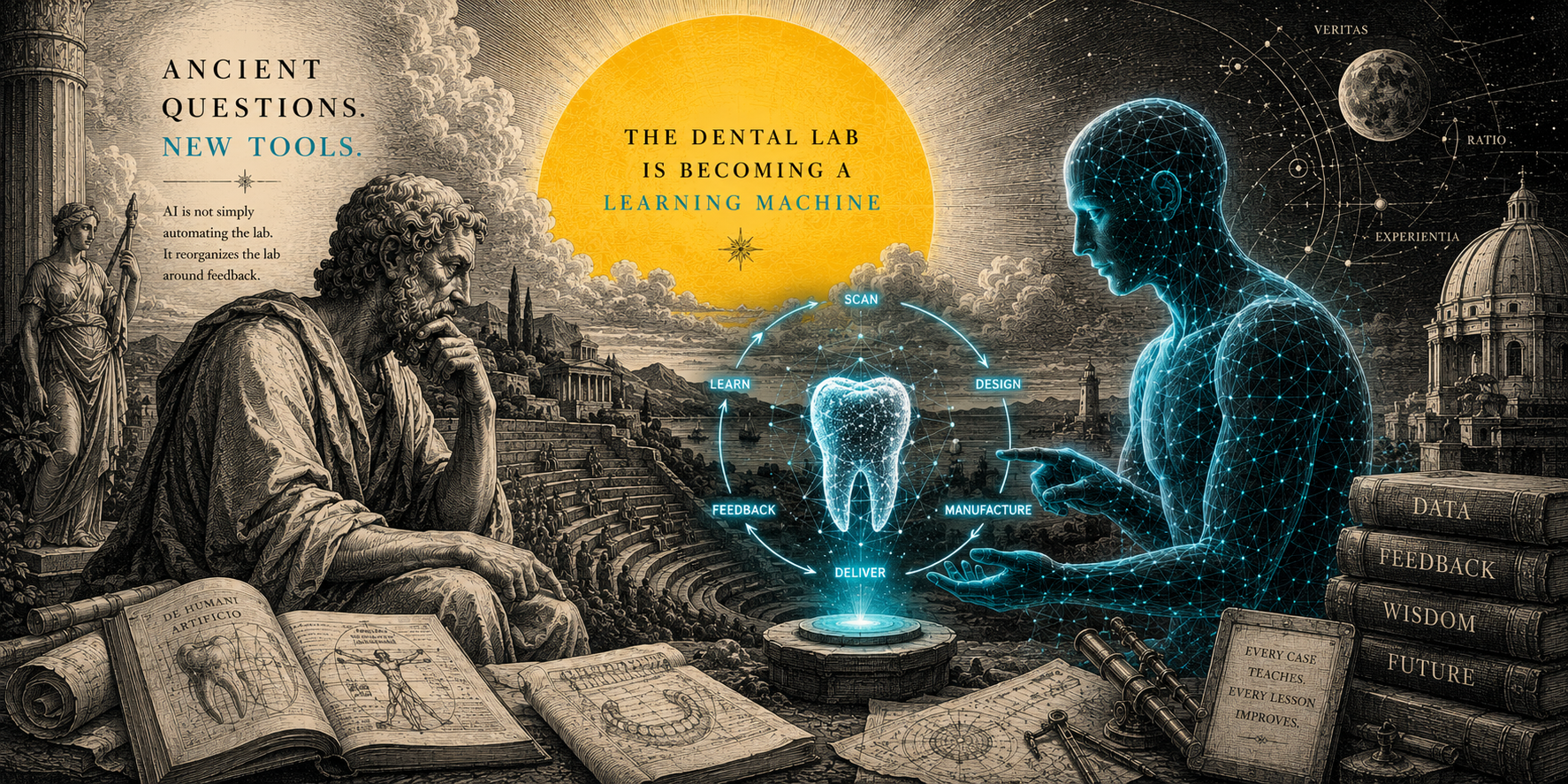
AI is not just automating dental design. It is reorganizing the laboratory around a closed-loop system where every case teaches the next.

Editor in Chief
Executive Abstract
The first wave of digital dentistry changed the tools; the next wave changes the operating model. This article explores how artificial intelligence is transforming dental laboratories from case-by-case production shops into closed-loop manufacturing systems. By turning every scan, design edit, remake, and doctor preference into structured data, AI reorganizes the lab around continuous feedback. The analysis highlights why morphology under constraint makes dentistry an ideal fit for machine learning, why the operational bottleneck is shifting upstream to case readiness, and how the role of the technician is evolving from manual designer to quality strategist. Ultimately, the most defensible advantage for a modern dental lab is not the speed of its milling machines, but the depth of its learning moat.
Quick Answer
Dental labs are evolving into "learning machines." AI is not just for designing crowns; it creates a feedback loop where every case teaches the next. By tracking patterns in remakes, scan quality, and doctor preferences, labs can automate routine work and focus human expertise on complex cases, resulting in higher predictability and fewer clinical adjustments.
Key Findings
- The Crown Is Not the Product: Commercially durable advantages come from the workflow system around AI models, not just the generative models themselves.
- Closed-Loop Manufacturing: Modern labs are becoming systems where every production error, margin issue, and adjustment improves the next case.
- Two-Lane Production Model: Labs are bifurcating into an "automation lane" for high-volume routine work and an "expert lane" for complex, esthetic, and implant cases.
- Case Readiness is the New Bottleneck: The operational focus is shifting upstream from production speed to the quality of the digital input (scans, margins, reduction).
- Feedback as a Competitive Moat: Proprietary data on doctor behavior, material performance, and production outcomes creates a defensible advantage that generic AI tools cannot replicate.
- Technicians as Quality Strategists: AI handles repetitive design labor, allowing skilled technicians to move up the value chain to handle exceptions, QC, and clinical communication.
Main Editorial Analysis
The first wave of digital dentistry changed the tools. The next wave changes the operating model.
For years, dental labs have adopted new technology in pieces: a scanner here, a mill there, a CAD station, a 3D printer, a portal, a design outsourcing partner. Each tool promised speed. Each tool improved part of the workflow. But the lab itself often remained what it had always been: a case-by-case production shop held together by technician skill, tribal knowledge, and heroic turnaround efforts.
Artificial intelligence is different. Not because it can design a crown in seconds. That is impressive, but it is not the real story. The real story is that AI pushes the dental lab toward becoming a closed-loop manufacturing system: a business where every scan, design, remake, doctor preference, margin issue, contact adjustment, and production error becomes data that improves the next case.
That is the deeper lesson running through the industry's shift toward AI-generated crowns and broader research on AI in restorative dentistry. AI does not simply automate the lab. It reorganizes the lab around feedback. And that distinction matters.
The Crown Is Not the Product. The Workflow Is.
Most conversations about dental AI start in the wrong place. They focus on the output: an AI-designed crown, an automated aligner setup, a generated nightguard, a proposed bridge design. That is understandable. The output is visible. It feels magical. A technician who once spent meaningful time designing a posterior crown can now receive an AI draft almost instantly.
But a crown design is only one event inside a much larger system. Before the design, there is the scan. Before the scan, there is the prep. Around the scan, there is case communication: margin clarity, reduction, bite, shade, material choice, doctor preference, delivery expectation. After the design, there is QC, nesting, milling, sintering, staining, glazing, finishing, packaging, delivery, seating, adjustment, and sometimes remake.
AI only creates durable advantage when it is connected to all of that. A company's advantage is not just the model. It is the system around the model. This is the first practical lesson for dental labs: AI is not a feature. AI is an operating layer.
A lab that plugs AI into a messy workflow will get some benefit. It may design routine units faster. It may reduce some bottlenecks. But it will not capture the full value. The full value comes when the lab redesigns itself around a simple question: What can this case teach us that improves the next one?
Why AI Fits Dentistry So Well
Dental restorations are strange products. They are mass-produced, but not standardized. Every crown is custom. Every patient has a different preparation, arch form, antagonist, occlusal pattern, bite relationship, esthetic expectation, and clinical limitation. A lab may make thousands of zirconia crowns, but no two cases are exactly the same.
That makes dentistry a natural fit for machine learning. Traditional CAD/CAM improved production by digitizing the workflow. But conventional CAD still depends heavily on libraries, rules, and technician adjustment. A technician chooses a tooth form, adapts it, refines contacts, adjusts occlusion, manages contour, checks minimum thickness, and tries to make the restoration work clinically.
AI changes the starting point. Instead of beginning with a generic tooth library and pushing the design toward the patient, AI can begin with patterns learned from large numbers of cases. It can infer what a plausible crown should look like given the adjacent teeth, opposing arch, preparation, emergence profile, and available restorative space.
The essential technical insight is this: a crown is not just morphology; it is morphology under constraint. A pretty crown that does not seat, violates minimum thickness, creates occlusal trauma, or requires heavy chairside adjustment is not a good crown. AI only becomes clinically useful when it learns the relationship between shape, fit, function, and manufacturability.
The Evidence Is Promising, But Not Magical
The broader research supports a measured view. AI-assisted crown design can reduce design time, improve consistency, and produce restorations that are morphologically close to technician-designed or natural tooth forms. Some studies show AI-generated designs performing well on occlusal contact, morphology, and stress-distribution measures. Other studies show that while AI is much faster than novice designers, it does not consistently outperform experienced technicians in morphological accuracy.
That should not disappoint anyone. It should clarify what AI is good for. AI is very good at producing a strong first draft. It is good at standardizing routine work. It is good at reducing repetitive design labor. It is good at creating consistency across large volumes of similar cases. It is good at helping less experienced technicians get closer to acceptable output more quickly.
But AI is not yet a substitute for expert judgment in every situation. It does not fully understand a doctor's intent. It may not handle rare edge cases well. It depends on scan quality, training data, indication type, software constraints, and the workflow around it. It may perform well on posterior single units but still require careful oversight for anterior esthetics, full-mouth rehabilitation, implant hybrids, complex bridges, and unusual occlusion.
The best mental model is not replacement. It is leverage. AI lets skilled technicians spend less time doing repetitive work and more time reviewing, refining, diagnosing exceptions, communicating with doctors, and managing complex cases. The technician does not disappear. The technician moves up the value chain.
The New Lab Has Two Lanes
AI will not affect every case equally. The future dental lab will likely operate with two distinct production lanes.
The first lane is the automation lane. This is where routine posterior zirconia crowns, simple bridges, copings, models, nightguards, and other high-volume indications flow through standardized digital intake, AI-assisted design, rapid technician QC, and automated manufacturing. The goal in this lane is speed, consistency, low remake rate, and predictable turnaround.
The second lane is the expert lane. This is where anterior esthetics, implant complexity, full-arch cases, difficult shades, large restorative plans, unusual occlusal schemes, and premium doctor relationships live. The goal here is not maximum automation. The goal is excellent judgment, communication, planning, and customization.
The mistake is trying to run both lanes the same way. Routine posterior work should not be treated as artisanal from scratch every time. That makes the lab too slow and too expensive. Complex esthetic work should not be treated as commodity automation. That puts the lab's reputation at risk. The strategic lab owner will separate the work. AI handles the repeatable. Humans own the exceptional.
The Bottleneck Moves Upstream
When labs talk about AI, they often ask: "How good is the design?" That is the second question. The first question is: "How good is the input?"
AI is only as good as the data entering the system. In a dental lab, that means scan quality, margin visibility, preparation design, reduction, bite accuracy, antagonist capture, implant scan-body accuracy, shade documentation, photos, material selection, and doctor instructions. A poor scan does not become a great restoration because AI touched it. In fact, AI may make bad input more dangerous because it can produce a confident-looking design on top of weak clinical information.
This creates a major shift for labs. The bottleneck moves from production skill to case readiness. A lab that wants to benefit from AI should build a digital intake protocol before obsessing over the AI tool itself. One practical idea is a digital case readiness score. Each incoming case can be evaluated on simple criteria: Is the margin clear? Is the bite usable? Is there enough occlusal clearance? Are adjacent contacts captured accurately?
Cases that pass move quickly. Cases that fail get flagged early. This matters because the cheapest remake is the one prevented before design begins.
The Technician Becomes a Quality Strategist
The old lab hierarchy rewarded hand skill, speed, and experience at the bench. Those still matter. But the AI-era lab adds new forms of value. The technician of the future may spend less time designing every crown from scratch and more time doing work like:
- Reviewing AI-generated designs and handling exceptions.
- Validating margins, contacts, occlusion, contour, and material thickness.
- Managing doctor-specific preferences.
- Identifying recurring scan or prep issues and investigating remake patterns.
- Training junior technicians on digital review.
- Communicating with doctors about case quality.
This is a different job. It is less repetitive and more analytical. Less "draw the crown again" and more "why did this case fail, and how do we prevent the next one?" In a well-run AI workflow, the senior technician becomes a force multiplier.
The Feedback Loop Is the Moat
The strongest labs will not be the ones that simply advertise "AI-designed crowns." That will become common. The strongest labs will be the ones that can answer questions like: Which doctors have the highest scan rejection rates? Which indications produce the most remakes? Which AI designs require the most manual editing? Which materials are most associated with adjustment or failure?
That is where the real advantage lives. A lab that measures these patterns can improve faster than one that merely works harder. This is especially important for relationships with larger practices and DSOs. Big clients may care about price, but they also care about predictability. They want fewer remakes, fewer chairside adjustments, reliable turnaround, and consistent outcomes across providers.
Original Insight
The pitch changes from craft alone to measurable reliability: "We track remake reasons, scan quality, design edit time, doctor preferences, and QC failures. We use that data to improve your cases." That is much more powerful.
AI Turns Doctor Education Into a Product
There is another underappreciated implication: AI and digital workflows give labs better ways to educate doctors. Historically, doctor feedback has often been episodic and emotional. A case fails. Someone is frustrated.
A data-driven lab can turn that into something more useful. Imagine telling a doctor: "Over your last 30 crown cases, six had unclear distal margins, four had low occlusal clearance, and three required contact adjustment after seating. The fastest cases had clear margins, full-arch antagonist scans, and prep photos. Here is the scan and prep checklist that will move more of your cases into our fast-track workflow."
That is not criticism. That is partnership. The lab can become a practice-improvement partner. AI makes that easier because it forces the lab to define what "good input" actually means. Once the lab defines it, it can teach it.
A Maturity Model for the AI-Era Lab
Most labs will move through five stages of maturity:
- The digital lab: Receives scans and uses CAD/CAM, but depends on manual decisions and scattered communication.
- The automated lab: Uses AI design and automated nesting. It gets faster, but may not yet understand why failures happen.
- The measured lab: Tracks remake rates, scan issues, edit time, turnaround, and QC failures. It begins to see patterns.
- The connected lab: Integrates doctor preferences, approval workflows, and structured feedback. Communication becomes part of the product.
- The learning lab: Continuously improves from its own data. Intake rules improve. AI review improves. Doctor education improves. Manufacturing improves.
The Uncomfortable Middle
AI will create pressure at the center of the market. Commodity work will get faster and more price-competitive. Premium work will remain relationship-driven, esthetic, consultative, and expert-led. The danger is being stuck between those two worlds.
A lab that is too manual to compete on routine posterior production, but not specialized enough to command premium fees for complex work, will feel squeezed. Every lab needs a clear strategy. A high-volume lab should pursue automation and measurable consistency. A boutique esthetic lab should use AI to remove routine work and protect senior technician time for premium cases.
The New Promise of the Dental Lab
The dental lab has always been an invisible partner in clinical dentistry. AI gives labs a chance to make that expertise more visible. Not by replacing craftsmanship with software, but by making the whole workflow more transparent, measurable, and improvable.
The best labs will be able to say: "We do not just make restorations. We run a system that improves them." The crown is still the thing that ships. But the workflow is the thing that compounds.
Clinical and Industry Implications
For Dentists
Clinicians will receive more objective feedback on their preparations and scans. This data-driven partnership helps reduce remakes and chairside adjustment time, ultimately improving the patient experience. The lab becomes a clinical coach, not just a manufacturer.
For Dental Laboratories
Lab owners should segment work into "automation lanes" for routine posterior units and "expert lanes" for complex esthetics. Success depends on building a digital intake protocol that ensures high-quality data enters the system before design even begins.
For Manufacturers & Software Companies
Equipment and material vendors must provide software that easily exports performance data, allowing labs to integrate production signals into their internal learning loops. Closed ecosystems that trap data will lose to open platforms that facilitate learning.
For DSOs
Large groups can use lab-provided data to identify provider-specific preparation patterns, turning the lab into a practice-improvement partner for clinical standardization across hundreds of locations.
For Investors
The valuation premium will shift toward laboratories that demonstrate a "learning moat"—a proprietary dataset of production outcomes, doctor behaviors, and remake patterns that continuously improves their efficiency and quality.
What Remains Uncertain
The "learning machine" model depends entirely on structured data. Many labs still rely on unstructured notes and fragmented communication, making it difficult to build a truly automated feedback loop. Furthermore, while AI is excellent at routine morphology, its ability to handle rare clinical edge cases, complex full-mouth rehabilitations, or highly customized esthetic demands without heavy human intervention remains a long-term challenge.
Definitions
- Closed-Loop Manufacturing
- A production process where data from the final output and its performance is used to automatically adjust and improve the initial design and production steps.
- Case Readiness Score
- An objective evaluation of incoming clinical data (scans, preps) to determine if it meets the quality threshold for successful manufacturing.
- Automation Lane
- A dedicated production workflow for high-volume, routine indications (like posterior single units) optimized for speed, consistency, and AI-driven design with rapid human QC.
- Learning Moat
- A competitive advantage built through a proprietary feedback loop that makes a system smarter and more efficient as it processes more data.
Frequently Asked Questions
What is a closed-loop manufacturing system in dentistry?
A closed-loop system is one where every output (e.g., a crown) and its performance (e.g., fit, remakes) becomes data that is fed back into the system to improve the next design and production cycle.
Is AI replacing dental lab technicians?
No. AI is acting as a force multiplier, automating repetitive, high-volume tasks so that skilled technicians can focus on quality control, complex esthetic cases, and clinical communication.
How does AI improve crown design?
AI uses patterns learned from millions of successful cases to propose designs that respect occlusal constraints and adjacent tooth morphology, often producing a strong 'first draft' in seconds.
What is digital case readiness in a lab?
This is a scoring system that evaluates incoming scans for margin clarity, reduction, and bite usability before they enter the production workflow, preventing expensive remakes.
Why is feedback the 'moat' for dental labs?
The strongest labs are those that track patterns in remakes, doctor preferences, and material performance, using that data to improve faster and provide more predictable results than competitors.
Citation-Ready Summary
"The dental laboratory industry is transitioning from manual production to closed-loop manufacturing systems powered by artificial intelligence. By integrating feedback from clinical outcomes, scan quality, and technician edits directly into the production workflow, laboratories are becoming 'learning machines' that prioritize system optimization over isolated tool adoption. This shift enables laboratories to scale capacity, reduce remakes, and evolve the role of the technician from a bench-worker to a quality strategist."
Source Notes & References
Note: Company-authored operational claims should be interpreted as company-reported unless independently validated in peer-reviewed literature.
- Dentistry Today - Ask the Expert: Sergei Azernikov on AI in the Dental Lab & More.
- Glidewell - Better Crowns with Artificial Intelligence: Reduced Chair Time and Fewer Remakes.
- arXiv - Learning Beyond Human Expertise with Generative Models for Dental Restorations.
- Ding et al. - Morphology and mechanical performance of dental crown designed by 3D-DCGAN.
- Nagata et al. - Verification of the accuracy and design time of crowns designed using artificial intelligence-equipped CAD software.
- Wu et al. - Comparison of the Efficacy of Artificial Intelligence-Powered Software Programs for Dental Crown Design.
- Kong et al. - Application of artificial intelligence in dental crown prosthesis: a scoping review.
- Hosseinimanesh et al. - Personalized dental crown design: A point-to-mesh deep learning approach.
- Bessadet et al. - Time efficiency and cost analysis between digital and conventional workflows for fixed dental prostheses.
- Pozzi et al. - Photogrammetry Versus Intraoral Scanning in Complete-Arch Digital Implant Impression: A Systematic Review and Meta-Analysis.
- Pozzi et al. - Accuracy of complete-arch digital implant impression with intraoral optical scanning and stereophotogrammetry.
- 3Shape Automate - AI-powered dental design service.
- 3Shape Support - 3Shape Automate in Dental System.
- Dentbird - AI dental CAD platform.
- SoftSmile Vision - Software for orthodontic labs.
- Institute of Digital Dentistry - LMT LAB DAY Chicago 2025 - All New Releases.
- American Dental Association - Artificial Intelligence in Dentistry standards page.
- ADA News - What are the standards for AI use in dentistry?
- FDA - Artificial Intelligence-Enabled Medical Devices.
- FDA - Marketing Submission Recommendations for a Predetermined Change Control Plan for Artificial Intelligence-Enabled Device Software Functions.
- NIST - AI Risk Management Framework.
- Australian Dental Association - Policy Statement 6.34: Artificial Intelligence in Dentistry.
- LMT - State of the Industry 2025 series.
- LMT - Top Challenges in the Laboratory and How to Tackle Them.
- LMT - State of the Subcontracting Market: Stronger and More Dynamic than Ever.
- LMT - State of Orthodontic Market: Digital Dominates.
- Lincoln International - Dental's Global Sector Health in 2025.
About the Author
Norbert Ulmer is the founder of DentalRevolution.ai™ and CEO of Gro3X.
Over the past three decades he has worked across Europe, Asia, and North America in leadership roles spanning dental technology, digital workflows, CAD/CAM, manufacturing, and business strategy.
Today he focuses on helping dental professionals understand how artificial intelligence, automation, software, and connected workflows are transforming dentistry.