Beyond Dashboards: The Rise of Dental Operating Intelligence
How AI is turning dental practice data into decisions, workflows, and accountability.

Editor in Chief
In this article
Executive Abstract
Dental Operating Intelligence is emerging as a critical layer above the dental practice management system (PMS). Unlike static dashboards that merely display historical data, operating intelligence uses AI to interpret data, prioritize actions, assign workflows, and track outcomes. This shift from retrospective reporting to continuous operating loops addresses the growing pressures of multi-location scaling, staffing shortages, and revenue leakage, transforming how dental organizations manage care continuity and business health.
Quick Answer
Dental Operating Intelligence is an AI-assisted management layer that turns practice data into actionable workflows. It moves beyond traditional dashboards by answering not just "what happened," but "what needs attention today, who owns the next step, and did the action work?"
Key Findings
- Visibility to Action: The dashboard is no longer enough; visibility must transition into actionable operating loops.
- Integrated Intelligence: Dental Operating Intelligence integrates PMS data, AI explanations, and workflow assignments to close operational gaps.
- Core Loops: The most valuable operating loops focus on patient access, hygiene recall, treatment follow-up, revenue cycle, schedule optimization, and multi-location management.
- Data Readiness: Dirty data combined with AI can create confident confusion, making data discipline a prerequisite for AI readiness.
- Ethical Boundaries: As clinical AI crosses into operations, practices must maintain ethical boundaries to prevent clinical findings from becoming mere production quotas.
The Monday Morning Gap
Monday morning in a dental practice has a familiar rhythm.
The schedule is full in some places and strangely thin in others. Hygiene has openings that were not there on Friday. A few patients on today’s schedule have large unscheduled treatment plans sitting quietly in the PMS. Insurance claims are aging. Someone cancelled late.
The dentist wants to know whether the practice is growing. The office manager wants to know what needs attention first. The team wants the day to stop feeling like controlled chaos.
The data is there.
It is in the practice management system. It is in the phones. It is in the claims platform. It is in the online scheduling tool. It is in the call recordings, patient forms, reminders, reviews, payment links, treatment plans, recall lists, and spreadsheets.
But the practice does not really see itself.
That is the gap Dental Operating Intelligence is beginning to fill.
Not another dashboard. Not another static report. Not another consultant scorecard printed at the end of the month. Dental Operating Intelligence is the emerging layer that tries to turn dental practice data into timely explanations, prioritized actions, team accountability, and eventually bounded automation.
The old question was: “How did we do last month?”
The new question is: “What needs attention today, why does it matter, who owns the next step, and did the action actually improve care, cash flow, or capacity?”
That is a very different kind of practice management.
And it may become one of the most important AI stories in dentistry.
The dashboard was never the destination
For years, dental practice analytics followed a familiar path.
First came PMS reports. Production reports. Collections reports. Aging reports. Recall reports. Treatment-plan reports. Claims reports. Provider reports.
Then came spreadsheets. The dentist or office manager exported data, cleaned it up manually, built scorecards, and tried to make sense of the numbers.
Then came consultants, who often brought structure, benchmarks, accountability, and a clearer way to interpret the chaos.
Then came dashboards. Instead of digging through dozens of reports, practices could see pro- duction, collections, hygiene, case acceptance, recall, AR, no-shows, new patients, and provider performance in one place.
That was progress.
But the dashboard was never the destination.
A dashboard can show that collections are down. It may not explain whether the issue is insurance timing, patient balances, claim delays, adjustment patterns, payer mix, posting errors, or a change in the schedule.
A dashboard can show that hygiene reappointment is weak. It may not tell the team which patients should be contacted first, which open hygiene slots should be filled, who owns the outreach, or whether yesterday’s calls created kept appointments.
A dashboard can show unscheduled treatment. It may not distinguish stale treatment plans from urgent follow-up opportunities, accepted treatment from declined treatment, affordability issues from communication breakdowns, or clinically appropriate care from production wishful thinking.
A dashboard creates visibility.
But visibility is not the same as operating intelligence.
The next layer has to interpret, prioritize, assign, and close the loop.
That is the essence of the category.
Dental Operating Intelligence, defined simply
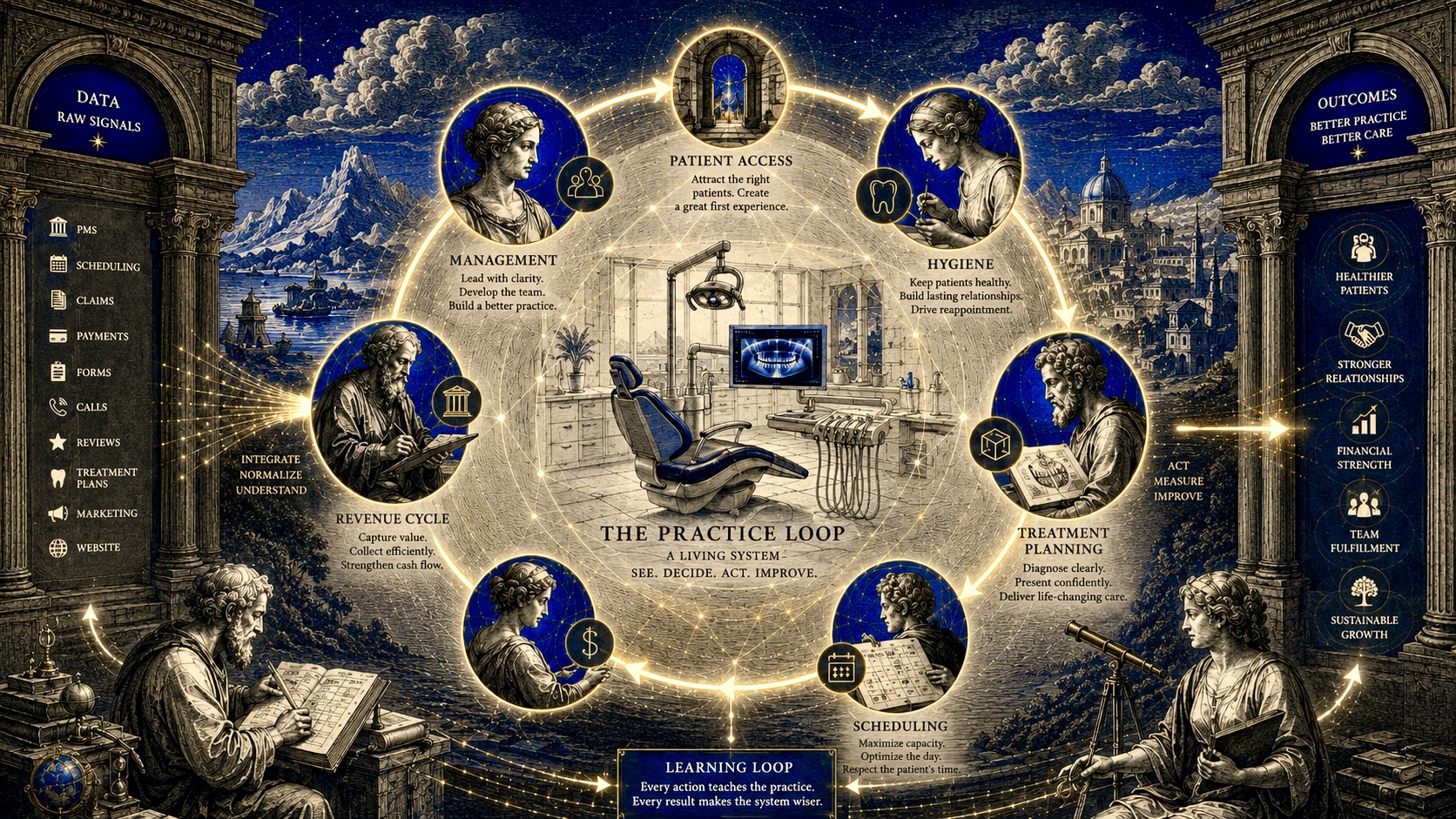
Dental Operating Intelligence is the AI-assisted operating layer above the dental PMS that turns practice data into decisions, workflows, and accountability.
It helps a dental organization know what matters, why it matters, what to do next, who should do it, and whether it got done.
That final phrase matters most.
A system that only shows numbers is analytics.
A system that changes the management rhythm of the practice starts to become operating intel- ligence.
The shift looks like this:
| Stage | What it answers |
|---|---|
| PMS reports | What happened? |
| Dashboards | What is visible? |
| Alerts | What changed? |
| AI explanations | Why might it have changed? |
| Recommendations | What should we do next? |
| Tasks | Who owns it? |
| Follow-up | Did it happen? |
| Learning loop | Did it work? |
Dental Operating Intelligence is not a single feature. It is a management pattern.
It typically combines PMS integration, KPI normalization, real-time or near-real-time monitor- ing, AI explanations, anomaly detection, natural-language queries, daily huddle support, patient follow-up lists, revenue-leak detection, marketing attribution, claims and collections prioritization, provider and location scorecards, regional manager dashboards, workflow assignment, auditabil- ity, and governance.
No single company owns the category yet.
But the shape of the category is becoming clear.
Dentistry is building a new decision layer.
Why now?
The obvious answer is AI.
But AI is only part of the story.
Dental Operating Intelligence is emerging because dentistry is under operational pressure.
The economic model of practice is changing. ADA Health Policy Institute data show that DSO affiliation more than doubled from 7.2% of dentists in 2015 to 16.1% in 2024. Among dentists up to 10 years out of dental school, DSO affiliation reached 26.5% in 2024. That matters because multi-location dentistry cannot be managed well through office-by-office reports and anecdotal check-ins alone. [1]
At the same time, practices face staffing, insurance, and overhead pressure. ADA/HPI’s State of the Dental Economy research identified insurance, staffing, and overhead costs as major chal- lenges for dentists heading into 2026. In another ADA/HPI update, only 60% of dentists reported having an adequate number of hygienists, and 91% of dentists actively or recently recruiting hy- gienists said hiring was very or extremely challenging. [2] [3]
The labor market reinforces the point. The U.S. Bureau of Labor Statistics projects continued growth and thousands of annual openings for dental hygienists and dental assistants. That does not mean every practice feels the same pain, but it does mean the human layer of dental operations is under pressure. [4] [5]
And then there is technology. PMS systems, cloud platforms, APIs, patient communication tools, call tracking, claims platforms, clinical AI, and AI agents are beginning to connect. Open Dental’s documentation is especially revealing: it warns that unsafe third-party database writes can cor- rupt records and may not be traceable in the audit trail, while API-based methods are generally safer for third-party integrations. [6] [7]
That is the real “why now.”
Practices need more management leverage.
DSOs need standardization.
Teams need clearer priorities.
Patients need better follow-up.
Vendors finally have the technical tools to connect data, explanation, and workflow.
The result is not merely better analytics.
It is the beginning of a new operating layer.
The practice does not need more data. It needs better loops.
The deepest shift is from reports to loops.
A report is a static object. It tells you something happened.
A loop has a signal, an interpretation, a decision, an owner, an action, a follow-up, a result, and learning.
That is the real unit of Dental Operating Intelligence.
Take hygiene recall.
The old model is simple: pull an overdue recall list when someone has time.
The operating-intelligence model is different. It identifies overdue patients, segments them by like- lihood to return, matches them to open hygiene capacity, recommends outreach, assigns follow-up, tracks booking, tracks kept appointments, and learns which outreach worked.
Take accounts receivable.
The old model is to run an aging report and start with old balances.
The operating-intelligence model separates insurance AR from patient AR, identifies claim-status issues, payer patterns, posting delays, collectability, and team ownership. It does not just say, “AR is high.” It says, “These are the claims or balances most likely to matter this week.”
Take marketing.
The old model counts leads or new patients.
The operating-intelligence model follows the path from campaign to call, call to booked appoint- ment, booked appointment to kept visit, kept visit to diagnosis, diagnosis to accepted treatment, accepted treatment to completed production, and completed production to collected revenue.
That is the difference between visibility and intelligence.
The future dental practice will not be managed by more charts.
It will be managed by better operating loops.
Six loops that matter most
If Dental Operating Intelligence becomes useful, it will not be because it produces impressive charts. It will be because it improves specific loops inside the practice.
1. The access loop
A patient calls, texts, books online, fills out a form, confirms, cancels, reschedules, or no-shows. This used to be treated as front-desk administration.
It is now intelligence infrastructure.
The access loop asks:
Did demand become an appointment? Did the appointment become a kept visit? Did patient fric- tion become visible? Did the practice learn which sources, messages, times, and team behaviors actually produce access?
A traditional dashboard may show new patients are down. The access loop may reveal why: calls were missed, online booking was too limited, the schedule had no attractive openings, insurance questions were mishandled, or one campaign produced low-intent callers.
2. The hygiene loop
A hygiene patient is due, overdue, scheduled, cancelled, reappointed, or lost.
The hygiene loop asks:
Who needs recall outreach? Which patients are most likely to return? Which open hygiene slots can be filled responsibly? Which patients left without reappointment? Which outreach actually produced kept visits?
This is where operating intelligence can support both care continuity and practice health. Hygiene is not just production. It is the rhythm of preventive dentistry.
3. The treatment loop
A condition is diagnosed. A treatment plan is created. A patient understands—or does not understand—the need. Financing is discussed. The appointment is scheduled, delayed, declined, or forgotten.
The treatment loop asks:
Which treatment plans are current? Which are stale? Which patients need education, not pres- sure? Which accepted treatment was never scheduled? Which provider or coordinator workflow needs support?
This is also where the ethical stakes rise. Not every unscheduled treatment plan is appropriate revenue. Not every AI-identified finding should become a production target. Operating intelli- gence must help patients complete appropriate care, not turn clinical judgment into a quota.
4. The revenue-cycle loop
A claim is created. Documentation is attached. Eligibility is checked. The claim is submitted. It is paid, delayed, denied, corrected, appealed, written off, or transferred to patient responsibility.
The revenue-cycle loop asks:
Which claims are stuck? Which payers are slowing cash flow? Which balances are collectible? Which adjustments are misclassified? Which office or central team owns the next action?
A dashboard can show AR aging. Operating intelligence should help the team decide what to work first.
5. The schedule loop
A chair opens. A provider has unused time. A cancellation happens. A patient could be moved sooner. A hygiene gap appears. A short-call list exists, but no one has time to work it.
The schedule loop asks:
Which gaps matter? Which patients fit clinically and logistically? Which openings are realistic to fill? Which no-show patterns are predictable? Which schedule templates are creating chronic underuse?
Schedule optimization is not simply filling every opening. A full schedule that exhausts the team or pressures inappropriate care is not intelligence. It is noise with a production goal.
6. The management loop
A metric changes. A location drifts. A provider pattern emerges. A regional manager needs to know where to focus. An owner needs to know whether the practice is actually improving.
The management loop asks:
What changed? Is it real? Why might it have happened? Who owns the response? Did the intervention work?
This is the loop that matters most for groups and DSOs. Without it, multi-location management becomes dashboard theater: lots of numbers, too little clarity.
Who is building the category?
Dental Operating Intelligence is not being built by one type of company. It is emerging from several directions at once.
These examples are not endorsements. They are signals of where the market is moving.
Analytics-first platforms such as Root Data, Dental Intelligence, Practice by Numbers, Jarvis Ana- lytics, and Practice Analytics are moving from dashboards and scorecards toward AI summaries, coaching, workflow prompts, and action recommendations. Root Data, for example, explicitly positions itself as an AI-powered optimization layer for Open Dental practices and emphasizes read-only access, AI Coach, AI Chat, KPI monitoring, and alerts. [8] [9]
PMS-native platforms are also moving in. Planet DDS has promoted DentalOS, open APIs, Den- ticon, Cloud 9, and AI agents for scheduling and confirmation workflows. Dentrix Ascend’s Prof- itability Insights, powered by Jarvis, focuses on metrics such as case acceptance, unscheduled treatment, retention, hygiene reappointment, production, and collections. [10] [11]
Patient-access and communication platforms such as NexHealth, Weave, RevenueWell, Patient Prism, and CallRail are building intelligence around calls, online booking, reminders, reviews, cancellations, no-shows, missed opportunities, patient conversations, and marketing attribution. [12] [13] [14]
Revenue-cycle platforms such as Vyne Dental and Overjet are adding intelligence around eligibil- ity, claims, attachments, payment workflows, payer communication, and review processes. [15] [16]
Clinical AI companies such as Pearl and Overjet are connecting diagnostic intelligence to oper- ational workflows, including treatment follow-up, case presentation, documentation, insurance evidence, and DSO analytics. Pearl’s Practice Intelligence, for example, explicitly pairs radiologic AI with practice data to identify unscheduled and AI-detected needs. [17]
AI receptionist and agent companies such as Arini, Viva, VoiceStack, Sikka.ai, and others are attacking the front-office execution layer: calls, scheduling, confirmations, recall, payments, and patient routing. [18] [19] [20]
The category is fragmented.
That is the point.
Dental Operating Intelligence is not yet a clean software category. It is a convergence zone where analytics, PMS systems, patient engagement, clinical AI, revenue cycle, call intelligence, and AI agents are all moving toward the same question:
How does a dental organization turn data into action?
The biggest opportunity is silent leakage
Every dental practice has leakage.
Some of it is obvious. Open time in the schedule. Broken appointments. Aging claims. Patient balances.
But much of it is quiet.
A patient leaves hygiene without reappointment. A crown is diagnosed but never scheduled. A new-patient call goes unanswered. A treatment plan remains open but stale. A claim is delayed. A payer adjustment is misclassified. A patient cancels and never returns. A marketing campaign produces calls, but the calls do not convert. A regional manager sees a location underperforming but does not know whether the issue is staffing, scheduling, collections, treatment planning, or data entry.
Traditional dashboards can reveal pieces of this.
Operating intelligence tries to connect the pieces.
The phrase “revenue leakage” can sound aggressive, and it should be used carefully in dentistry. Not every unscheduled treatment plan is appropriate revenue. Not every overdue patient is ready to return. Not every diagnosed condition should become a production target. Not every theoreti- cal opportunity becomes ethical, affordable, completed, and collected care.
But the underlying idea is valid.
Patients do fall through the cracks.
Hygiene continuity does break down.
Claims do age unnecessarily.
Calls are missed.
Schedules are underfilled.
Treatment conversations are not always followed up.
Dental Operating Intelligence matters when it helps practices see these patterns early enough to act responsibly.
The best version of the category is not about squeezing more production out of patients.
It is about reducing avoidable operational failure.
Clinical AI is crossing into operations
The most sensitive boundary is the convergence of clinical AI and operating intelligence.
Clinical AI can detect radiographic findings, support diagnosis, improve documentation, assist pa- tient education, and help calibrate providers. But once those findings are connected to treatment plans, unscheduled care, case acceptance, insurance evidence, provider scorecards, and revenue opportunities, clinical AI enters the operating layer.
This is powerful.
It may help practices follow up with patients who genuinely need care. It may reduce missed diag- noses, improve documentation, support insurance claims, and help patients understand treatment needs more clearly.
It is also risky.
Clinical findings can become production pressure. AI-detected needs can become revenue targets. Provider comparisons can become unfair. Hygienists and dentists can feel monitored by systems that do not fully understand clinical nuance, patient affordability, medical complexity, or informed consent.
This is where dental leadership matters.
The ethical line should be clear:
AI can support diagnosis, documentation, education, and follow-up.
AI should not convert clinical judgment into a production quota.
The best operating-intelligence systems will respect the boundary between care continuity and revenue extraction.
The worst will blur it.
Dirty data plus AI equals confident confusion
The hidden constraint behind the whole category is data quality.
Dental data is messy.
Appointment statuses are inconsistent. Treatment plans go stale. Patients are duplicated. Providers are misattributed. Adjustments are poorly categorized. Recall intervals vary. Insurance payments lag. Claims live across multiple systems. Marketing sources are captured inconsistently. Deleted appointments disappear from view. Multi-location groups use different templates, codes, and workflows. Consultants define KPIs differently. PMS systems use different logic. Office teams develop local habits that never appear in documentation.
AI does not magically solve this.
In fact, AI can make dirty data more dangerous because it may generate confident explanations from flawed inputs.
If case acceptance is defined inconsistently, the AI may explain the wrong trend. If treatment plans are stale, the AI may inflate opportunity. If provider attribution is wrong, the AI may unfairly judge clinicians. If adjustment types are messy, the AI may misread collections. If marketing sources are incomplete, the AI may recommend the wrong spend. If appointment statuses are unreliable, the AI may misinterpret no-shows and cancellations.
The practical implication is simple:
Before a practice becomes AI-ready, it has to become data-ready.
That means defining KPIs, cleaning workflows, standardizing adjustment categories, auditing treatment-plan statuses, improving source capture, normalizing provider attribution, and assign- ing ownership for data quality.
The future practice will need a new kind of discipline.
Not just clinical discipline.
Not just financial discipline.
Data discipline.
Governance is now part of practice management
Dental Operating Intelligence touches patient data, financial data, claims data, provider perfor- mance, patient communications, schedules, and sometimes clinical findings.
That makes governance central.
HHS guidance makes clear that vendors performing functions involving protected health infor- mation on behalf of covered entities—including data analysis, billing, and practice-management services—can be business associates under HIPAA and require appropriate business associate agreements. [21]
That means dental practices and DSOs should ask vendors hard questions:
- Will you sign a Business Associate Agreement?
- What data do you access?
- Is the connection read-only or writeback?
- Which AI models or subprocessors process patient data?
- Is patient data used to train models?
- Are prompts and outputs stored?
- Can users audit AI-generated answers?
- Can the system drill down to source records?
- Are permissions role-based?
- Are cross-location views controlled?
- Are investor, consultant, or advisor permissions limited?
- Are writebacks logged?
- Can actions be approved before they affect the PMS?
- Can we export our data?
These questions may sound technical.
They are not.
They are practice-management questions now.
If AI becomes part of the operating system of dentistry, then AI governance becomes part of the responsibility of dental leadership.
The more a system can act, the more it must be governed.
The economic promise is real, but the math must be honest
Dental Operating Intelligence can create value.
It can help fill schedules, reactivate hygiene, improve collections, reduce AR, recover missed calls, improve claim follow-up, reduce marketing waste, support case follow-up, and improve regional management.
But buyers should be careful with ROI claims.
The most common mistake is confusing identified opportunity with realized revenue.
A system may identify hundreds of thousands of dollars in unscheduled treatment. That does not mean the practice will ethically schedule, complete, and collect that amount.
A system may show open chair time. That does not mean the practice has the staff, patient demand, or clinical appropriateness to fill it.
A system may rank marketing sources. That does not mean attribution is clean.
A system may identify provider variance. That does not mean the provider is underperforming.
The honest economic chain is longer:
- Opportunity identified.
- Action assigned.
- Patient contacted.
- Appointment booked.
- Appointment kept.
- Care accepted.
- Care completed.
- Revenue collected.
- Profit retained.
- Staff burden reduced.
- Patient trust preserved.
That is the real scorecard.
Any vendor can show opportunity. The valuable systems help practices convert appropriate op- portunity into completed care and healthier operations.
The danger is turning dentistry into a KPI machine
There is a real ethical risk here.
Dental Operating Intelligence can become a tool for better care continuity, clearer follow-up, and more sustainable practices.
It can also become a tool for production pressure, provider surveillance, staff burnout, investor- driven optimization, and subtle erosion of clinical autonomy.
The difference depends less on the software than on the operating culture around it.
Used well, the system says:
- These patients need follow-up.
- This claim is stuck.
- This hygiene patient fell through the cracks.
- This office needs support.
- This schedule gap can be filled with a patient who already needs care.
- This metric changed, and here is the likely reason.
Used poorly, the system says:
- This provider is not producing enough.
- This hygienist is not converting enough.
- This location is below benchmark.
- This patient segment is less valuable.
- This AI finding is a revenue opportunity.
Dentistry should be measured.
But it should not be reduced to measurement.
A healthy practice needs production, collections, and accountability. It also needs judgment, trust, care, restraint, and professionalism.
The best Dental Operating Intelligence will support those values.
The worst will quietly replace them.
Clinical and Industry Implications
For DSOs and Groups
They need cross-location reporting, standardized KPIs, provider comparisons, regional manager workflows, acquisition diligence, post-acquisition integration, marketing allocation, centralized RCM, hygiene performance, schedule utilization, executive dashboards, and investor reporting. For a DSO, Dental Operating Intelligence may become a required management layer.
For Independent Practices
The great promise for solo dentists and small groups is not enterprise analytics. It is relief from overwhelm. AI acts as a tireless junior operating analyst to summarize, sort, flag, draft, explain, and prepare, reducing the cognitive burden of practice management.
For Dental Labs
Dental labs are not the primary buyers of Dental Operating Intelligence today. But they should watch the category closely.
If practices and DSOs become better at understanding treatment pipelines, schedule capacity, restorative demand, and case-flow patterns, the downstream relationship between practice and lab may become more predictable. The lab may never see the practice’s operating dashboard, but it will feel the effects of a practice that understands its own restorative pipeline more clearly.
What dental professionals should do now
The practical path is not to rush into AI.
It is to build the operating foundation that makes AI useful.
Start by defining the key terms:
- What exactly is production?
- Is collection rate based on gross production, adjusted production, or collectible production?
- What counts as case acceptance?
- What is an active patient?
- What counts as a broken appointment?
- How is unscheduled treatment identified?
- How is hygiene recall measured?
- How is provider production attributed?
- How are adjustments categorized?
Then choose a few operating loops.
Not everything.
Just the loops that matter most now.
For many practices, the best starting points are:
- hygiene recall
- unscheduled treatment
- AR over 60 or 90 days
- missed calls
- broken appointments
- new-patient show rate
- schedule utilization
- claims follow-up
- marketing source quality
For each loop, define the trigger, owner, action, deadline, metric, and review cadence.
Then evaluate technology.
A good Dental Operating Intelligence tool should make one or more loops clearer, faster, safer, and more accountable.
If it only adds more charts, it may not be worth the burden.
If it creates hundreds of alerts with no ownership, it will create noise.
If it cannot explain its calculations, it should not be trusted.
If it cannot protect patient data, it should not be used.
If it cannot connect insight to action, it is not operating intelligence.
It is decoration.
The future practice will be managed differently
The future dental practice will not necessarily be larger.
It will not necessarily be corporate.
It will not necessarily be fully automated.
But it will be more aware of itself.
It will know when hygiene is slipping before the month ends.
It will know which claims are stuck before cash flow tightens.
It will know which patients need follow-up before treatment plans go stale.
It will know which marketing sources create real appointments, not just noise.
It will know which schedule gaps are meaningful.
It will know when the data is too messy to trust.
And, most importantly, it will know what to do next.
That is the quiet revolution inside Dental Operating Intelligence.
The technology may look like dashboards, alerts, AI chats, agents, summaries, huddles, score- cards, and workflows.
But the real transformation is managerial.
Dentistry is moving from retrospective reporting to continuous operating judgment.
From data as memory to data as guidance.
From dashboards that display the practice to systems that help the practice act.
The winners will not be the practices with the most software.
They will be the practices that learn how to close the loop.
They will ask better questions. They will define their metrics. They will clean their data. They will protect their patients. They will support their teams. They will use AI as a disciplined assistant, not a magic authority.
And they will remember that the goal of intelligence in dentistry is not optimization for its own sake.
The goal is better care, better operations, healthier teams, more sustainable practices, and fewer patients falling through the cracks.
That is what Dental Operating Intelligence could become.
Not another dashboard.
A practice learning how to see itself — and act wisely on what it sees.
Citation-Ready Summary
"Ulmer, N. (2026). Beyond Dashboards: The Rise of Dental Operating Intelligence. DentalRevolution.ai. This article explores the transition from static dental practice analytics to AI-driven operating intelligence, emphasizing the shift from data visibility to actionable management loops."
Source Notes & References
- ADA/HPI — U.S. Dentist Workforce Report 2025
- ADA/HPI — State of the U.S. Dental Economy, Q4 2025
- ADA/HPI — Dental Hygienist Shortage
- BLS — Dental Hygienists Occupational Outlook
- BLS — Dental Assistants Occupational Outlook
- Open Dental — Integration Types
- Open Dental — Database Integrity / Third-Party Integration Risk
- Root Data — Homepage
- Root Data — FAQ
- Planet DDS — DentalOS AI Agents Announcement
- Dentrix Ascend — Profitability Insights Suite
- NexHealth — Analytics
- Weave — Analytics
- Patient Prism — Dental / DSO Solution Page
- Vyne Dental — Homepage
- Overjet — Homepage
- Pearl — Practice Intelligence
- Arini — Y Combinator Company Profile
- Viva AI — Homepage
- Sikka.ai — Homepage / Self-Driving Practice Positioning
- HHS — Business Associates under HIPAA
Disclaimer: This article is editorial analysis for dental professionals and is not legal, regulatory, medical, or clinical advice. Practices should consult qualified counsel, compliance advisors, and clinical experts before adopting patient-facing AI tools with real patient data.
About the Author
Norbert Ulmer is the founder of DentalRevolution.ai™ and CEO of Gro3X.
Over the past three decades he has worked across Europe, Asia, and North America in leadership roles spanning dental technology, digital workflows, CAD/CAM, manufacturing, and business strategy.
Today he focuses on helping dental professionals understand how artificial intelligence, automation, software, and connected workflows are transforming dentistry.