For Lab Owners, the AI Denture Opportunity Starts Before Design
The next shift in removables is not a magic design button. It is AI-assisted intake discipline, bad-record detection, setup review, and production handoff.

Editor in Chief
In this article
Executive Abstract
The integration of Artificial Intelligence into removable prosthodontics is frequently misunderstood as a quest for fully autonomous, one-click denture design. However, for dental laboratories, the true value of AI lies upstream in the workflow. This article examines how AI-assisted case intake, clinical record validation, and guided design proposals can alleviate critical capacity constraints in removable departments. By automatically detecting inadequate scans, validating prescriptions, and generating robust initial setups, AI systems allow senior technicians to shift from manual drafting to high-level review and quality control. The analysis concludes that the near-term success of AI in dentures will not be defined by the elimination of the technician, but by the implementation of intelligent process controls that reduce friction, minimize avoidable remakes, and scale scarce clinical expertise.
Quick Answer
The real opportunity for AI in digital dentures is not replacing the technician with a "magic design button." It is using AI to automatically review incoming cases, reject bad clinical records (like poor scans or vague prescriptions) before they enter production, and provide a strong first draft. This allows senior lab technicians to focus on reviewing and approving cases rather than starting from scratch, significantly increasing lab capacity and reducing costly remakes.
Key Findings
- The Bottleneck is Intake, Not Design: Denture failures are rarely due to CAD errors; they stem from poor clinical records, unclear vertical dimensions, and vague prescriptions.
- AI as a Quality Gate: The most valuable function of early AI in removables is rejecting inadequate inputs and preventing unworkable cases from consuming valuable technician time.
- Multiplying the Expert: AI proposals allow senior removable technicians to transition from primary designers to reviewers and exception handlers, scaling their expertise across more cases.
- Copy Dentures as the Entry Point: Reference-driven workflows, such as copy dentures, provide a structured starting point making them the most viable near-term application for AI assistance.
- Process Discipline is Required: AI cannot rescue a bad clinical record. Labs must define minimum record packages and validate post-processing protocols before scaling AI workflows.
If you own a dental lab, the most important AI denture question is not, “Can software design an arch in two minutes?” It is, “Can this workflow keep routine cases from getting stuck in my most constrained department?”
That distinction matters. Dentures are not just another product line. They are a capacity problem. They require judgment that many labs have in limited supply, and that judgment often sits with one or two senior removable technicians whose calendars already control turnaround time.
For a lab owner, the metric that matters is not first-draft design speed. It is total case friction: intake clarification rate, rejected or rerouted cases, first-draft edit time, senior-tech minutes per arch, record-driven remake rate, post-delivery adjustment burden, turnaround variability, and the number of arches a trained reviewer can approve per day.
A system that reduces that friction is more valuable than a demo that produces a denture setup quickly but still lets weak records, vague prescriptions, and questionable bites pass into production.
That is why AI matters in removables. The win is not a magic button. The win is a workflow that catches bad inputs earlier, gives routine cases a stronger starting point, routes exceptions to the right technician, and makes scarce removable expertise easier to apply across more cases.
The bottleneck is the case, not the design button
A removable case rarely fails only because a tooth was placed badly in CAD. It fails because the bite was questionable. The vertical dimension was unclear. The scan missed tissue information. The prescription was vague. The midline was not communicated. The old denture contained useful information, but no one captured it. The lab did not know what the doctor wanted until the case was already in production.
That is why dentures are a different automation problem than crowns. A crown is usually constrained by a prep, margin, adjacent contacts, opposing occlusion, and material thickness. A denture is a full-arch prosthetic relationship. It depends on clinical records, soft tissue, occlusion, esthetics, lip support, border extension, patient adaptation, and technician judgment.
The 2025 expert consensus on digital complete dentures describes denture design as a system of landmarks, denture-base extension, esthetic references, facial-profile considerations, tooth arrangement, virtual articulation, and static and dynamic occlusion. In other words, a denture is not just a shape. It is a chain of clinical decisions.[1]
An AI tool that only draws a denture but cannot tell whether the case package is useful will not solve the lab problem. The valuable product is not just the design button. It is everything around the design button.
What “AI-native” should mean in removables
In dentures, “AI-native” should not mean a model independently designs, approves, and manufactures a prosthesis. That is the wrong standard and the wrong story.
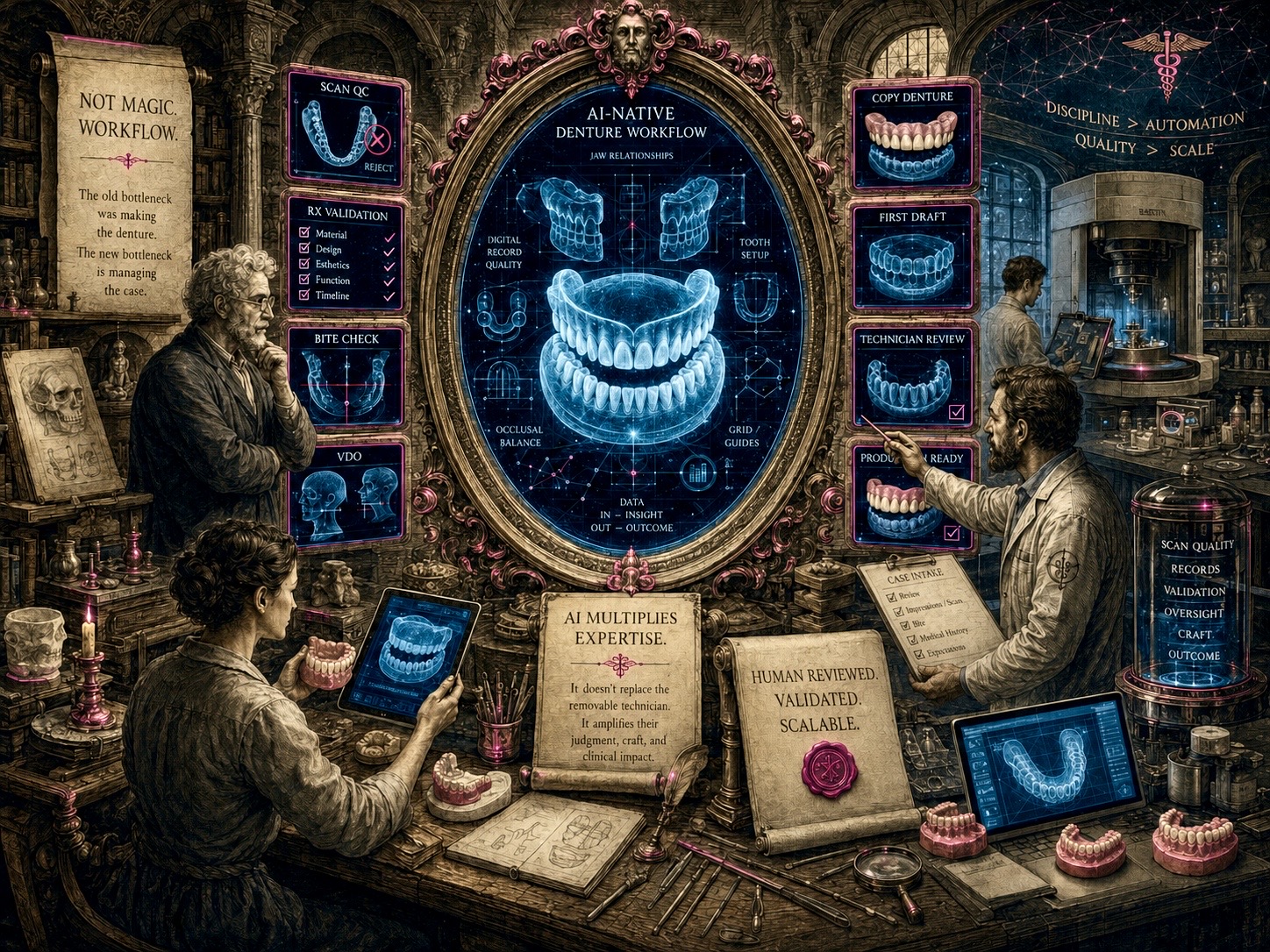
A practical definition is more useful: AI is built into the denture case from intake to production handoff. It checks scan quality. It reads the prescription for missing information. It flags bite-record risk. It proposes a tooth setup. It routes exceptions. It gives the technician a better first draft. It helps produce a file that fits the lab’s validated print or mill workflow.
Call that AI-native or simply AI-assisted. The business question is the same: does it reduce friction without weakening clinical responsibility?
The first valuable AI job is to reject bad inputs
The future of AI dentures may begin with saying “no.”
No, this scan is not good enough. No, this Rx is missing required information. No, this bite relationship is not reliable. No, this case should not go straight to design.
That sounds less exciting than two-minute CAD. It is probably more valuable.
Bad records are not only a clinical risk. They are business leakage. Every unclear VDO, unstable bite record, missing reference, and incomplete prescription creates a hidden tax on the lab: emails, calls, holds, redesigns, reprints, remake exposure, and senior-technician interruption.
AvaDent’s clinical-record guidance shows how much success still depends on front-end information: vertical dimension, bite relationship, impressions or digital scans, reference records, existing dentures, try-in records, and workflow-specific clinical inputs. Its centric-relation guidance reinforces the need for stable bases, accepted vertical dimension, repeatability, and verification in edentulous patients. The scanning literature adds another constraint: intraoral scans of completely edentulous arches still face accuracy challenges, especially around mobile peripheral tissues.[2]
This is the uncomfortable truth behind AI dentures: AI cannot rescue a weak record package, but it may help identify weak records earlier.
The expert is not eliminated. The expert is multiplied.
The most important customer for AI-assisted dentures may not be the specialized removable lab that already has deep bench strength. It may be the general-service lab that wants to offer dentures but does not have enough removable expertise to scale the department confidently.
The useful question is whether AI can reduce the amount of senior removable expertise required on every routine case.
If software can validate scans, check prescription completeness, propose tooth setups, flag questionable bite records, route exceptions, and generate a better first draft, then a senior removable technician can spend more time reviewing and less time starting from zero.
That does not eliminate the expert. It multiplies the expert.
The technician becomes a reviewer, standards-setter, exception handler, and trainer of the system. Junior designers can become productive sooner. Senior technicians can focus on cases that actually need them. Output becomes less dependent on one person. Capacity becomes less fragile.
That is the lab-owner business case: fewer intake stalls, fewer rebuilds, fewer avoidable record-driven remakes, and more predictable production.
The product market is moving upstream
Product signals already point in this direction. SmileShape is interesting not only because it markets fast full-arch denture design, but because its public positioning combines scan quality control, prescription validation, CAD design, and production handoff. That is a case-management story, not just a CAD story.
3Shape is also pushing AI deeper into lab workflows, including AI bite alignment and reported AI-supported steps in copy-denture workflows. Exocad continues to package guided full-denture design. SprintRay and AvaDent point toward cloud-supported or service-supported removable workflows that reduce local CAD burden. On the production side, Dentsply Sirona, Ivoclar, Formlabs, and Asiga show that validated print and mill ecosystems are becoming more mature.[3]
Those examples should be read as market signals, not proof that AI dentures are clinically solved. The point is narrower and more useful: the denture workflow is becoming digital enough, structured enough, and data-rich enough for AI to matter.
Evidence check: digital dentures are real; AI denture workflows are early
The evidence base is stronger for digital dentures than for AI dentures.
Recent systematic reviews generally support the practical value of digital and hybrid complete-denture workflows, including time and cost efficiency, similar or better clinical performance compared with conventional workflows in some measures, and promising occlusal accuracy. Patient-reported outcomes remain more nuanced and are not determined by manufacturing method alone.[4]
The AI-specific evidence is earlier. Recent reviews of AI in prosthodontic design describe potential gains in efficiency, accuracy, and consistency, but also emphasize the need for validation, workflow integration, diverse datasets, algorithm refinement, and multicenter trials. Early denture-specific work on AI-assisted tooth arrangement is promising, but it is not the same as proof that end-to-end autonomous denture production is ready.[5]
For lab owners, the conclusion should be practical: digital dentures are commercially and clinically real; AI-assisted denture workflows are emerging on top of them. Pilot AI as process control and reviewer leverage, not as a replacement for responsibility.
The best wedge may be copy dentures
If I were watching this category as a lab owner, I would pay special attention to copy dentures.
A copy-denture workflow gives the system a reference point. The existing denture contains information about tooth position, patient adaptation, vertical dimension, esthetic expectations, flange contours, and functional compromises. It may not be perfect, but it gives the AI and technician something to reason from.
That makes copy dentures a natural bridge from traditional digital dentures to AI-assisted removable workflows. The near-term opportunity is not “AI invents the denture from nothing.” It is “AI helps interpret and streamline a reference-driven workflow.”
That is likely where AI will work first: structured workflows such as reference dentures, routine full dentures, try-ins, duplicate dentures, and simple single-arch cases with good opposing records. The near-term winner is constrained automation, not full autonomy.
Demand is durable. Capacity is the question.
Dentures are not disappearing. CDC oral-health surveillance data show edentulism rising with age, including 11.4% among adults 65-74 and 19.7% among adults 75 and older in the reported 2017-March 2020 data. The U.S. Census Bureau reported that the U.S. population age 65 and older reached 61.2 million in 2024.[6]
The labor backdrop is more complicated. BLS projects overall employment for dental and ophthalmic laboratory technicians and medical appliance technicians to decline slightly from 2024 to 2034, while still expecting thousands of annual openings due to replacement needs.[6]
That combination matters. Demand remains. Labor capacity is constrained. Software does not need to replace removable technicians to be valuable. It only needs to make scarce people more productive and less interruptible.
AI will reward process discipline
People hear “AI denture design” and imagine skill moving from the technician into the software. In removables, the opposite may happen. AI may raise the value of fundamentals.
The dentist needs better records. The lab needs clearer intake rules. The technician needs review standards. The production team needs validated material and post-processing workflows. The business needs outcome tracking.
A vague Rx is not magically improved because a model read it. A bad bite is not magically corrected because software aligned it. A poor scan is not a digital transformation. It is a digital liability.
A lab does not need to bet the company on AI dentures today. The smarter move is to prepare the workflow:
- Define the minimum record package for each denture case type.
- Track why cases are rejected, held, or sent back for clarification.
- Separate routine cases from exception cases before design starts.
- Measure senior-technician minutes per arch, not just CAD time.
- Create review standards that junior designers and outside design partners can follow.
- Test copy-denture workflows where existing dentures provide a strong reference point.
- Track remakes and adjustments by cause, especially record-driven causes.
- Validate print, mill, cure, bonding, finishing, and documentation protocols before scaling volume.
AI will be most useful where the process is already measurable.
Responsibility remains human, documented, and auditable
Dentures are not consumer gadgets. They are prosthetic medical devices delivered through a clinical relationship.
The American College of Prosthodontists emphasizes the importance of quality impressions, casts, scans, and complete prescriptions in the dentist-laboratory relationship. The ADA’s policy on direct-to-consumer dental services reinforces that the dentist-provider remains responsible for prosthetic care. FDA resources on AI-enabled medical devices and recent dental-device enforcement activity are reminders that technology does not erase the responsibility layer.[7]
For labs, the lesson is not to fear AI. It is to keep the chain of responsibility clear.
Dentist-prescribed. Human-reviewed. Documented. Material-validated. Workflow-controlled.
That is the version of AI-assisted dentures that can scale responsibly.
The bigger takeaway
The future of removables will not be technician-free. It will be bottleneck-light.
That is the real promise of AI-assisted dentures: not a magic button, not a fully autonomous lab, and not a world where clinical judgment disappears.
A better version is more practical. The doctor captures better records. The system checks the case before design. The AI proposes a first draft. The technician reviews, edits, and approves. The lab produces through a validated print or mill workflow. The case data become reusable, measurable, and improvable.
Digital workflows made removables more repeatable and data-rich. AI-assisted workflows may make removable judgment more guided, measurable, repeatable, and scalable. That is the shift.
Clinical and Industry Implications
For Dental Laboratories
Labs should pilot AI as a process control tool rather than a replacement for staff. Success depends on establishing clear intake rules and review standards for junior designers and AI outputs.
For Dental Professionals
Clinicians must understand that AI-assisted lab workflows demand higher quality clinical records, not lower. Accurate bite relationships and complete prescriptions remain the foundation of success.
For Manufacturers and Software Companies
Product development should focus on case-management features—scan quality control, Rx validation, and exception routing—rather than just design speed.
For the Labor Market
Despite AI advancements, the demand for skilled removable technicians will remain strong. Their roles will evolve toward orchestration, quality assurance, and complex problem-solving.
What Remains Uncertain
While digital dentures are commercially proven, fully end-to-end AI denture workflows remain in the early stages. The evidence base for AI-assisted tooth arrangement is promising but lacks large-scale, multicenter validation proving autonomous production is ready. Furthermore, it remains to be seen how effectively AI models can generalize across diverse clinical presentations and whether the financial ROI justifies the integration costs for smaller, general-service laboratories.
Definitions
- AI-Assisted Intake
- The use of algorithms to automatically evaluate incoming clinical records (scans, prescriptions, bite registrations) for completeness and accuracy before design begins.
- Copy Denture Workflow
- A digital process that uses a patient's existing denture as a reference point for tooth position, vertical dimension, and esthetics to design a new prosthesis.
- Vertical Dimension of Occlusion (VDO)
- The distance between two selected anatomic points (usually one on the tip of the nose and the other on the chin) when in maximal intercuspal position.
- Centric Relation
- The maxillomandibular relationship in which the condyles articulate with the thinnest avascular portion of their respective disks; a critical reference point in denture fabrication.
Frequently Asked Questions
Will AI completely automate denture design?
No. Dentures require complex clinical judgments regarding soft tissue, esthetics, and dynamic occlusion. AI will assist by providing strong first drafts and validating inputs, but human review remains essential.
Why are bad clinical records a business problem for labs?
Unclear records lead to emails, calls, production holds, redesigns, and remakes. This "hidden tax" consumes the time of highly skilled, constrained senior technicians.
What is the best way for a lab to start using AI for dentures?
Labs should begin with highly structured workflows like copy dentures, where an existing prosthesis provides a reliable reference for the AI and the technician.
Does AI reduce the need for senior removable technicians?
No, it multiplies their impact. By handling routine setups and flagging bad inputs, AI allows senior techs to review more cases and focus on complex exceptions.
Citation-Ready Summary
"The integration of artificial intelligence into removable prosthodontics represents a shift from manual drafting to intelligent workflow orchestration. Rather than pursuing fully autonomous design, the immediate value of AI lies in case intake validation, record quality control, and the generation of baseline proposals. By identifying inadequate clinical inputs early and standardizing initial setups, AI enables senior dental technicians to transition to supervisory roles, thereby addressing critical capacity constraints and improving production predictability in dental laboratories."
Source Notes & References
Compact source notes replace the source-reference table in the earlier draft. Product references are treated as market-positioning evidence, not independent proof of clinical performance.
- [1] Digital denture design complexity: 2025 expert consensus on digital complete dentures, International Journal of Oral Science / Nature Portfolio.
- [2] Input quality and scanning limits: AvaDent clinical-record requirements; AvaDent centric-relation guidance; 2024 systematic review on intraoral scans for completely edentulous arches.
- [3] Product and workflow signals: SmileShape; 3Shape and copy-denture AI coverage; exocad; SprintRay; AvaDent; Dentsply Sirona Lucitone; Ivoclar Ivotion; Formlabs Lucitone; Asiga / Lucitone.
- [4] Digital denture evidence: JPD digital/hybrid workflow review; JPD review/meta-analysis; Journal of Dentistry occlusal-accuracy review.
- [5] AI prosthodontics evidence: 2026 scoping review; 2026 narrative review; AI tooth-arrangement study (PMC full text).
- [6] Demand and labor: CDC Table 18 and selected findings; Census older-adults release; BLS outlook.
- [7] Responsibility and compliance: ACP position statement; ADA DTC dental policy; FDA AI devices list; FDA Reset warning letter.
Disclaimer: This article is editorial analysis for dental professionals and is not legal, regulatory, medical, or clinical advice.
About the Author
Norbert Ulmer is the founder of DentalRevolution.ai™ and CEO of Gro3X.
Over the past three decades he has worked across Europe, Asia, and North America in leadership roles spanning dental technology, digital workflows, CAD/CAM, manufacturing, and business strategy.
Today he focuses on helping dental professionals understand how artificial intelligence, automation, software, and connected workflows are transforming dentistry.